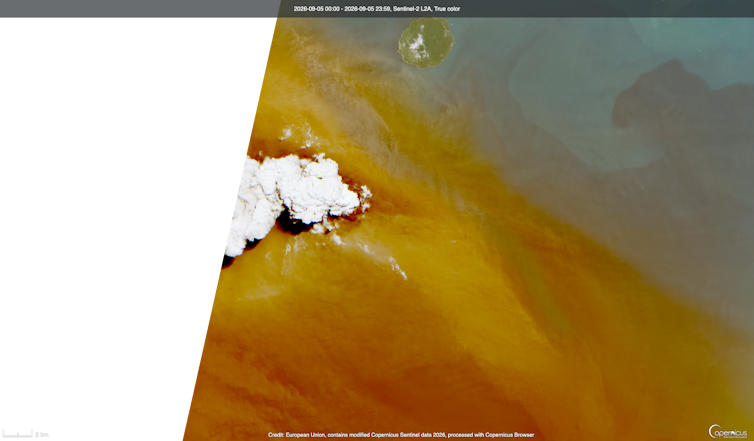
Indonesia’s Mount Anak Krakatau has erupted again this week, sending plumes of volcanic ash high into the sky and disrupting hundreds of flights. More than 300,000 passengers have been affected.
Anak Krakatau, meaning “child of Krakatau” in Indonesian, has erupted on and off for almost a hundred years. This volcano emerged from the devastation caused when its predecessor, Krakatau (also known as Krakatoa), famously erupted between May and August in 1883.
It’s hard to overstate just how big the 1883 eruption was, and the catastrophic and often strange impacts that followed.
The Moon went blue, sunsets went green and global temperatures fell. Around 35,000 people lost their lives, almost all in tsunamis caused by the eruptions. The sound of one of the 1883 explosions is still the loudest sound in recorded history; it could be heard “like the distant roar of heavy guns” near Mauritius, almost 5,000 kilometres away.
So what caused the 1883 eruptions – and could they happen again?
What caused the 1883 eruption?
Most volcanoes sit at the edges of Earth’s tectonic plates.
Krakatau sits above what’s called a subduction zone, where the Indo-Australian plate is forced beneath the Eurasian plate. This produces molten rock (or magma) with a lot of gas dissolved in it, which helps explain why Indonesian volcanoes can erupt so explosively.
There is still some debate about the main triggers at various stages of the eruption.
It was once thought the 1883 eruption was caused by seawater entering the volcanic system and interacting with the magma, leading to an explosive eruption.
However, deposits of volcanic material laid down in May 1883 contain two distinct layers: light-coloured pumice beneath a darker grey ash. The two layers are also chemically distinct, which suggests different magmas were involved.
One scientific interpretation for the initial trigger is that new, hot, gas-rich magma rose from deeper inside Earth and mixed with more viscous magma already stored beneath Krakatau, adding heat and dissolved gases and destabilising the system.
This process, known as magma recharge or mixing, may also have been a trigger or contributing factor in major eruptions such as:
The real danger in 1883 came from Krakatau’s location. Had it been on land, the main hazards would have been falling volcanic material (tephra) and the spread of pyroclastic flows (avalanches of gas, hot ash and rocks).
But as Krakatau was in the ocean, the pyroclastic flows and collapse of the volcanic edifice generated tsunamis, which killed more than 90% of those that died.
What were the impacts in Australia and around the world?
In Australia, strange rumbling sounds – described as resembling the “blasting of a rock” and “artillery at a distance” – were reported in August in Western Australia and the Northern Territory, around 3,000 kilometres from Krakatau.
Tsunamis generated by the eruption reached coastlines around Australia and New Zealand around the same time, with wave heights of more than two metres reported at several Australian locations. There were no reported human deaths but some livestock drowned in Western Australia.
At Geraldton in Western Australia, locals reported on one August evening seeing the sea suddenly recede “over 100 yards”, leaving fish stranded on the shore. Unaware of the impending danger, people collected the floundering fish, before the water suddenly returned with a loud rushing noise. Fortunately, there were no reported deaths.
An earthquake from the eruption was also reported in the Northern Territory on the evening of August 26.
The eruption’s effects lasted long after the event. Vast quantities of pumice floated along Australia’s coastlines for almost a year, and pumice rafts (where pumice fragments stick together to form thick floating platforms) travelled thousands of kilometres across the Indian Ocean.
By July 1884, pumice had reached Zanzibar on the east coast of Africa. A report to the Royal Society described how schoolboys on the shore in Zanzibar found stones that could float in water – as well as several “quite clean” human skulls and bones alongside them.
Krakatau also had a remarkable effect on the atmosphere.
Volcanic gases and fine particles were injected high into the atmosphere, where they remained suspended for months.
These tiny particles scattered the red light in the spectrum, while allowing blue light to pass through, making the Moon appear blue.
The large amount of sulphur dioxide gas released was oxidised in the atmosphere to form sulphate aerosols. These reduced the amount of sunlight that reached Earth’s surface, causing near-surface temperatures to drop by around 0.3°C for several years following the eruption.
Could it happen again?
It’s hard to say whether Anak Krakatau will, in future, produce a similar devastation to that in 1883. But we do know the volcano remains highly active. This could increase risk because eruptions may cause volcanic instability, potentially leading to collapse.
On the other hand, it could also reduce risk of a larger eruption over the longer term; these on-and-off eruptions may relieve the buildup of large volumes of viscous magma inside the volcano.
In 2018 a large eruption caused collapse of most of the existing around 300 metre high edifice and produced a deadly tsunami that killed more than 400 people. Since then, the volcano has remained relatively small. According to Indonesia’s National Disaster Management Agency (known locally by the acronym BNPB), it doesn’t currently have the potential to collapse on a scale that could trigger a tsunami.
What about the latest eruption?
The main hazard from the current eruption is via airborne ash, which is made of tiny, abrasive fragments of volcanic rock. It’s hazardous to inhale and can irritate eyes and skin.
It can also scratch the windshields of aircraft, rendering it difficult for pilots to see. It can cause aircraft engines to stall.
Copernicus Sentinel-2 satellite, CC BY-SA
Indonesia’s disaster management agency has urged anyone affected to remain calm and seek information from government authorities.
The agency has been performing post-eruption weather modification operations to remove ash from the atmosphere. This includes spraying water mist from planes in an attempt to make it rain.