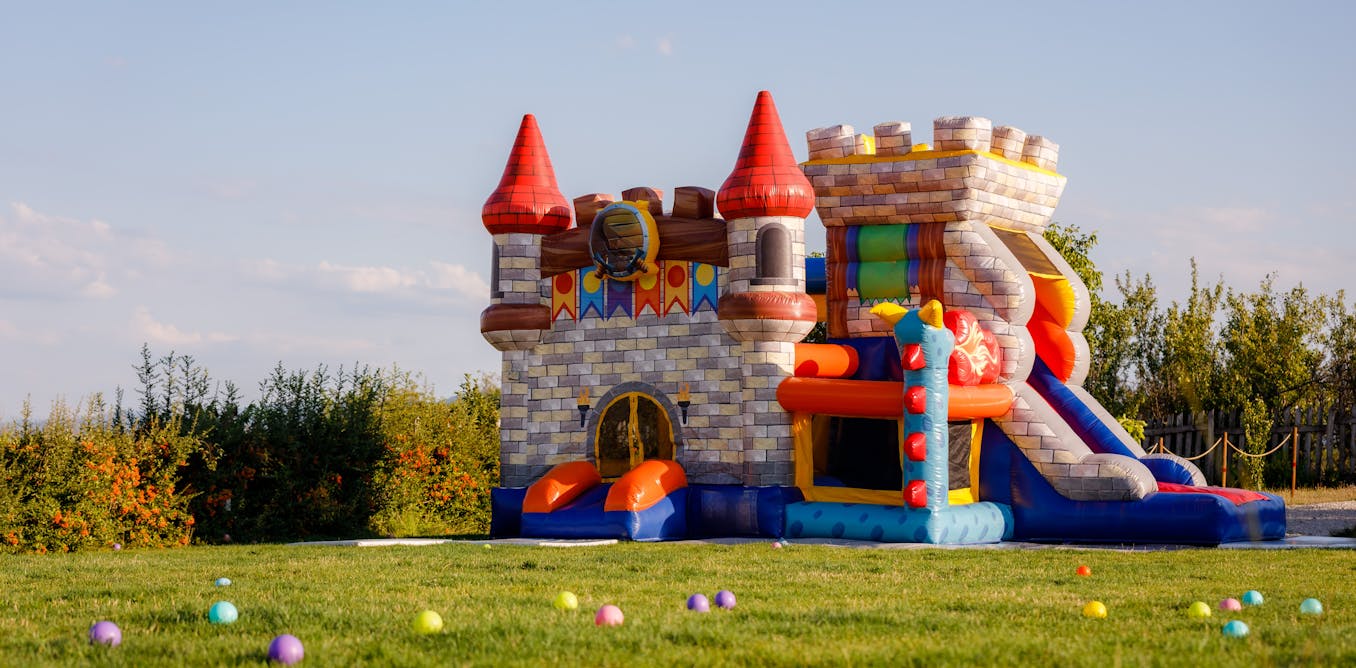
On Saturday, five children were hospitalised after two separate incidents in which jumping castles were lifted into the air by high winds.
In one incident, two children were tossed out of a jumping castle and received upper body injuries at a birthday party near Geelong in Victoria. In the second incident, in Sydney, two children and an infant were injured.
So should we be worried about letting kids on jumping castles? As an expert in the safety of amusement rides and playground equipment, I can say that jumping castles are for the most part very safe – as long as operators follow the safety rules.
So what are the rules?
In Australia, anyone operating an amusement ride needs to comply with the relevant health and safety laws. This is the Work Health and Safety Act in all states and territories except Victoria, which uses the Occupational Health and Safety Act.
How the legislation is interpreted is slightly different in each state and territory. However, for inflatable amusement rides they are all essentially the same.
Those state-based regulations in turn may require operators to comply with Australian Standard AS 3533. Australian Standards are national technical specifications designed to ensure products, services and systems are safe, reliable and consistent.
Safety requirements for inflatable amusement rides such as jumping castles are set out in Australian Standard AS 3533.4.1:2018.
Inflatables with a platform height of 3 metres or more must be “plant registered”, which means it has been checked for safety and registered with authorities. This can be done by certain chartered professional engineers.
In practice, all this means the design and manufacture of a jumping castle needs to comply with the standards. It also needs to be operated safely.
In particular, inflatable amusements must be securely anchored and should not be used when wind gusts are over 40 kilometres per hour.
What are the risks?
Assuming a jumping castle is in good repair and operated correctly, the greatest risk is posed by weather.
We don’t know exactly what happened in Saturday’s incidents, though it seems likely high winds played a role. Gusts of up to 90km per hour were forecast in Geelong, and speeds of 80km per hour were measured in Sydney. Nobody should be on a jumping castle in these conditions.
This is quite different from Australia’s most tragic inflatable incident in 2021, when six children died and three were seriously injured after a freak high wind picked up a jumping castle at Hillcrest Primary School in Tasmania. In that incident, the castle operator was found to have committed no crime as the wind was “unforeseeable”. (I was an expert witness in the court case.)
Climate change is also affecting what we can expect from weather. The conditions that create dust devils or willy willies like the one responsible for the Hillcrest tragedy – relatively small-scale atmosphic vortices that rise vertically as a combination of calm wind together with a hot ground surface – will become more common. More intense gusts of wind have already become more common.
Another concern is that it is easy to buy inflatable castles online from overseas suppliers which do not comply with Australian Standards and are not covered by Australian consumer protection laws. It is impossible for operators (or members of the public) to know how safe these devices are.
So are jumping castles safe?
In Tasmania, the aftermath of the Hillcrest tragedy saw jumping castles banned at public schools and on public land.
While this reaction was understandable, it also meant the end of a common childhood joy for many kids – and one that can be safe.
While the great majority of jumping castle operators in Australia follow regulations, there are some gaps in the current safety regime.
When purchasing an inflatable it is important to check the the product complies with AS 4333.4.1. A simple way to do this is to check the product is labelled as compliant with this standard.
If you’re operating an inflatable – or your kids are about to get on one – a simple way to check the wind speed is to use the Beaufort Scale: if the branches in small trees begin to sway it is time to start deflating the device.
High-profile tragedies don’t mean we should ban jumping castles or keep our kids off them. They do mean regulators should look at import loopholes and compliance with safety standards – and operators need to be even more careful to follow the rules and keep an eye on the weather.