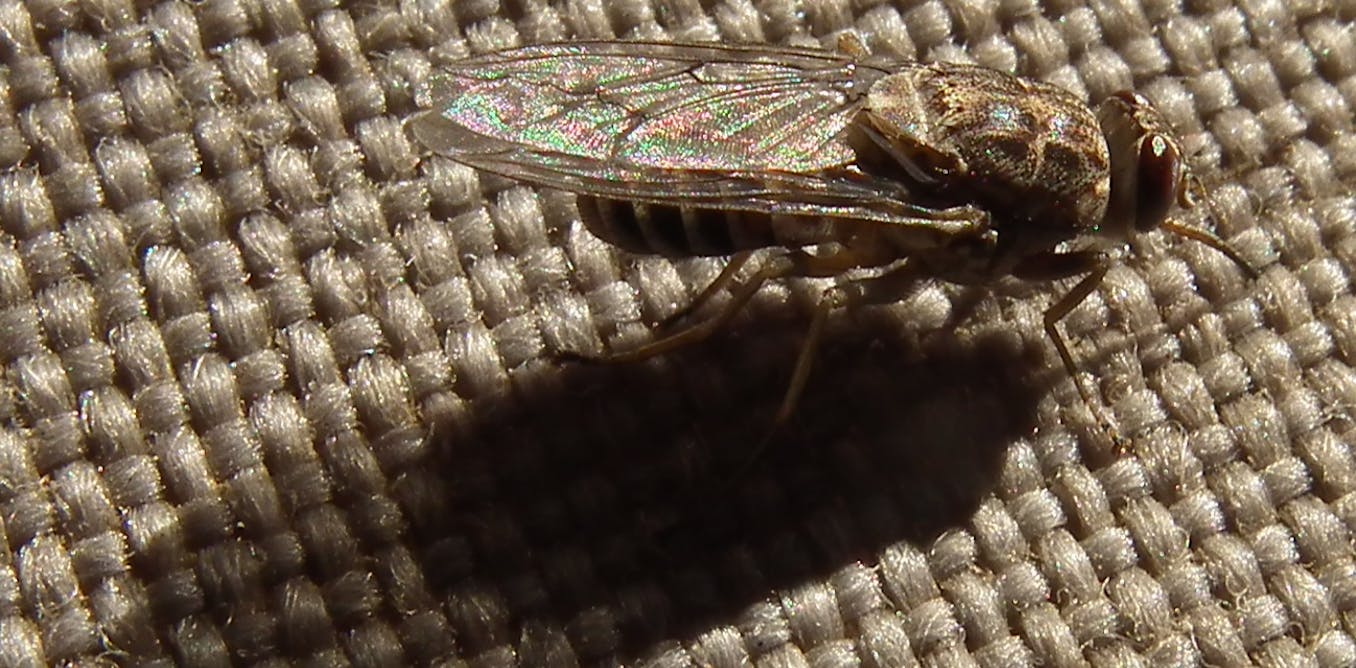
Tsetse flies transmit some of Africa’s most persistent parasitic diseases. They have affected human health, livestock production and rural development for generations, across a region spanning millions of square kilometres in 37 sub-Saharan countries.
Human African trypanosomiasis, or sleeping sickness, is caused by two species of single-celled parasites. Others infect wild and domestic animals, causing animal trypanosomosis, often called nagana in cattle.
Sustained surveillance, diagnosis and treatment have driven sleeping sickness to historically low levels, a remarkable public-health success. But animal trypanosomiasis remains a major problem, causing anaemia, weight loss, reduced productivity and fertility and death. For rural communities that depend on cattle for food, income and for use in tilling fields, the consequences extend far beyond the loss of individual animals. Across affected regions, the economic costs run into billions of US dollars.
Tsetse flies move between hosts. They take blood from humans and a wide range of wild and domestic animals, including elephants, buffalos, rhinos, hippos, turtles and monitor lizards. By moving between hosts, tsetse flies can connect wildlife, livestock and humans in complex transmission networks.
We are molecular cell biologists and parasitologists researching vectors, and we have extensive laboratory and field experience studying African trypanosomes and tsetse flies. Our work focuses on the interactions between parasites and their insect vectors, including the adaptations that allow tsetse flies to thrive across diverse ecosystems.
For a recent study, we assembled an international team spanning parasite biology and cell biology in Würzburg, vector research at the International Centre of Insect Physiology and Ecology in Nairobi and insect biomechanics in Kiel. We wanted to understand how the insects can penetrate such diverse skin types.
We detailed the anatomy and mechanical properties of the feeding apparatus and measured the forces a fly exerts while probing. We found its ability to pierce skin wasn’t due to one special “tool”. Instead, rows of tiny teeth, strong backward strokes of the mouthparts and flexible behaviour work together. The flies used the same pressure on very different natural skins and, when faced with reptile skin, selected softer gaps between scales.
This versatility helps explain how tsetse flies feed across such a broad host range – and therefore why they are so effective at carrying parasites among wildlife, livestock and humans.
More than a century of fighting tsetse
People have tried to control tsetse flies for more than a century. In Zimbabwe, for example, wildlife killing was used from at least the 1920s, while vegetation clearing continued into the early 1960s. Such environmentally destructive approaches have long been abandoned. Today, control methods include insecticide-treated cattle, odour-baited traps and targets, aerial spraying and the release of sterilised males.
These methods can eliminate local populations, but controlling tsetse across their vast and diverse range remains difficult and expensive.
We approached the problem from a different direction. Instead of asking how to kill a tsetse fly, we asked what makes it such a successful bloodsucker. The animals it feeds on present very different barriers, from relatively soft, pliable mammalian skin to the tougher, scaly skin of big reptiles. How can the same tiny fly bite such different animals?
To find out, our team combined high-tech imaging with micro-mechanical experiments. We filmed flies feeding, measured how strongly they attach and recorded the forces generated as their mouthparts moved through different types of skin.
Using natural tissues and artificial skin models, we could study the tsetse feeding apparatus as a complete biomechanical system.
A microscopic saw rather than a syringe
At the tip of the tsetse proboscis – the long, tube-like mouthpart it uses to pierce skin and drink blood – is an elaborate structure called the labellum, armed with rows of tiny teeth. During feeding, the labellum opens inside the skin, exposing these teeth, while the fly repeatedly pushes and pulls its proboscis through the tissue.
The forces generated when the fly pulled backwards were greater overall than those used to push forwards. That is counterintuitive: one might expect a piercing organ to do most of its work while being pushed into the skin. But once the labellum opens, its teeth face outwards. The stronger backward strokes may therefore act like a cutting motion, dragging those teeth through tissue, disrupting it and enlarging the feeding site.
This is fundamentally different from how a mosquito feeds. A mosquito uses extremely fine mouthparts to locate and tap individual blood vessels. Tsetse flies are pool feeders: they damage tissue until blood accumulates and then drink from the resulting pool.
If the mosquito feeding apparatus is a sophisticated syringe, the tsetse proboscis is closer to a microscopic saw.
The real superpower is versatility
We expected a fly capable of feeding on such different animals to possess some exceptional adaptation: enormous penetration forces, extraordinary grip or uniquely powerful mouthparts.
We found none.
Instead, tsetse flies succeed through subtle adaptations working together. They penetrated different types of skin using broadly comparable forces. Faced with reptile skin, they targeted softer regions between scales. Their feet provided sufficient grip, but their attachment was not exceptional compared with other insects.
The real tsetse superpower may therefore be versatility – combining anatomy, mechanics and behaviour to overcome very different physical challenges.
Could understanding the bite help fight the disease?
Our research does not immediately provide a new method for controlling tsetse flies. But it reveals an overlooked aspect of vector biology (how diseases are spread).
To transmit a parasite, a tsetse must successfully land, hold on, penetrate the skin, feed and escape the host’s defences. Each step presents a physical challenge, and potentially a vulnerability.
Understanding these mechanics could eventually inspire new ways to interfere with feeding or improve control technologies that exploit tsetse behaviour.
But our findings also help explain why these flies are such successful disease vectors. Its many small adaptations work remarkably well together. The result is a tiny fly capable of taking blood from an astonishing range of animals. For a parasite looking for its next host, it is difficult to imagine a better ride.