Deeply etched into a cliff face in GunaiKurnai Country, near the township of Buchan in East Gippsland in rural Victoria, is a large limestone cave that hosts an extraordinary story.
Today, the area outside Cloggs Cave is mainly grassland and open woodland, with eucalypt forests further behind the cave. But this was not always so.
The environment changed as the last ice age came and went, and as the Old GunaiKurnai Ancestors managed Country through cultural burning and daily activities on the land. Photographs from the 19th century, as well as regional pollen records, show that during the early colonial times of the mid- and late 1800s, sheoaks were more abundant.
Early colonists cleared nearly all those that then stood near Cloggs Cave. But it is their grassy understorey that is of greatest interest to this story, which we can now tell.
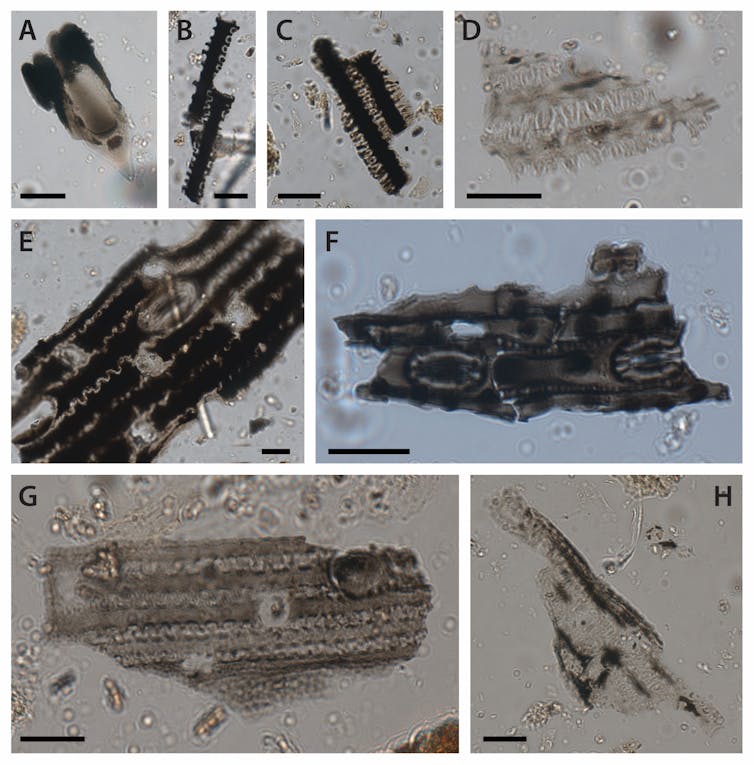
In a new paper published in the journal Frontiers in Environmental Archaeology, we report the discovery of thousands of microscopic plant remains known as phytoliths that are testimony to GunaiKurnai rituals repeatedly performed over the past 25,000 years.
Who carried the plants inside?
Phytoliths are microscopic silica bodies that occur in plant tissues, their shapes and sizes varying in different parts of plants and between plant taxa.
Unlike pollen, which is dispersed by wind or insects, the hard, glassy phytoliths mostly get left behind at the spot where a plant decays. They can survive underground for thousands and even millions of years. They can also survive fires.
As sediments accumulate, the phytoliths become trapped in the soil, so that over time the buried sequence leaves a record of the plants that once grew or had been placed there.
Plants cannot grow inside Cloggs Cave, as there is neither sufficient light nor moisture. So the buried phytoliths must have been carried in by people or by animals, such as possums, on their fur or through their scats.
Elle Grono, courtesy of the GunaiKurnai Land and Waters Aboriginal Corporation, CC BY-NC
A 25,000-year-old history
In 2019 and 2020, we were part of a team of scientists and local Aboriginal community members who undertook archaeological excavations deep in the cave, to work out how the Old GunaiKurnai Ancestors used it in the past.
As the excavations progressed, we collected small samples of sediment, one to two centimetres at a time. In the laboratory, we focused on the half-burnt phytoliths from the ashy layers, because these layers were clearly the result of fires lit by people inside the cave.
The burnt phytoliths were so concentrated they could not have been incidental to other activities nearby. They were found in thin layers of ash densely packed one on top of the other, unlike during earlier times when the ash was more sparse.
The phytoliths from the various ash layers had almost all come from different parts of grasses, such as stems, leaves, flowers and roots. This indicated the grasses had been brought into the cave whole, roots and all.
The archaeological excavations showed people had entered the cave for some 25,000 years, beginning just as the coldest phase of the last ice age began. They never used the cave for everyday living though, nor for communal food preparation or consumption.
There are hundreds of thousands of animal bones in the cave. But almost all of those dating to the period of human occupation came from owls dropping their pellets on the cave floor, mainly tiny unbroken bones.
Instead, people used the cave to perform secluded rituals, some involving the breaking of stalactites and the erecting of standing stones from blocks of limestone obtained from inside the cave.
A carefully positioned stone revealed
Some 73 thin, superimposed ash layers underlie and then surround one such, fully buried, standing stone.
The 28-centimetre-tall stone was positioned upright on a bed of ash 2,000 years ago, and fires were then regularly burnt around it over the next 400 years. The microscopic phytoliths in the thin layers of ash now reveal otherwise invisible traces of those activities.
We found 29 different types of phytoliths from a range of plant groups including grasses, herbs, and woody plants at different levels of the excavation. Most of the phytoliths were well preserved, and even delicate silica forms such as hair cells and multicellular structures had survived intact in their original plant positions.
Grasses were the most abundant plant type identified (up to 97%). Two subfamilies of grasses were particularly well represented: Pooideae, which grows in temperate, cool conditions, and Panicoideae, which prefers warm, humid climates.
Woody plants and herbs are low phytolith producers, and phytoliths from these plant types were rarely observed.

Bruno David, courtesy of the GunaiKurnai Land and Waters Aboriginal Corporation
Retelling the stories in the land
The phytoliths are more than an indication of the simple burning of grasses in the cave.
Senior members of the GunaiKurnai community told local pioneering ethnographer Alfred Howitt in the 1800s that individuals would be smeared with ash and charcoal powder during the jeraeil initiation ceremony and various other powerful rituals to perform healing, cursing and magic.
Plants were also laid and burnt on the ground to leave ashy floors to make it easier to track the footsteps of dangerous beings who may be lurking nearby, such as nargun who are thought to have lived in caves.
The details of these rituals have been partly forgotten over the years. But our research – together with GunaiKurnai people’s retained cultural knowledge of ancestral practices in local caves – is helping to unearth and make sense of them.
These were peopled landscapes whose rich stories can again be told.