In a world where trust in institutions is mostly in decline, levels of trust in science remain relatively high. Yet at the same time, belief in scientific conspiracy theories, such as hushed-up effects of vaccines or aeroplane “chemtrails”, is also widespread.
What explains this apparent contradiction? Our work suggests we need to ask a different question – not how much people trust science, but which sources inform their understanding of what science is and how it works.
In our recent study of 843 US residents, we found that people who picture scientific progress as the work of lone geniuses, and who learn about science mainly from podcasts and documentaries, are markedly more drawn to conspiracy theories – whatever their level of education.
This fits the bigger picture very well. In a 16-country survey, 70% of respondents believed at least one false or unproven health claim. High trust in science and widespread conspiracy beliefs appear to coexist in the same populations.
We fear that trust in science is compatible with believing almost anything, so long as it is expressed in plausibly scientific terms. This can lead to some people refusing vaccines, trusting miracle cures or dismissing climate warnings – all while remaining convinced that science is on their side.
The ‘lone genius’ trope
At school, science is almost always presented as a linear sequence of achievements, or in the form of impersonal theories. The human side of discovery is largely stripped out.
In contrast, most science-focused films and documentaries build their narratives around biographies of exceptional individuals.
These often yield a familiar plot. Society is facing an intractable problem. A genius arrives with the exact solution – but is ignored and mocked until, after much personal pain, everyone realises he (for it is invariably a man) was right all along.
From the martyrdom of Giordano Bruno, the Renaissance friar burned at the stake partly for defending an infinite universe, to A Beautiful Mind, the Oscar-winning portrait of the mathematician John Nash, this lone-genius arc has permeated popular depictions of science for centuries.
Many conspiracy theorists seek to exploit this trope – in part to suggest that those who recognise it must be unusually smart too, living in a world where everyone else is “naive” or “brainwashed”.
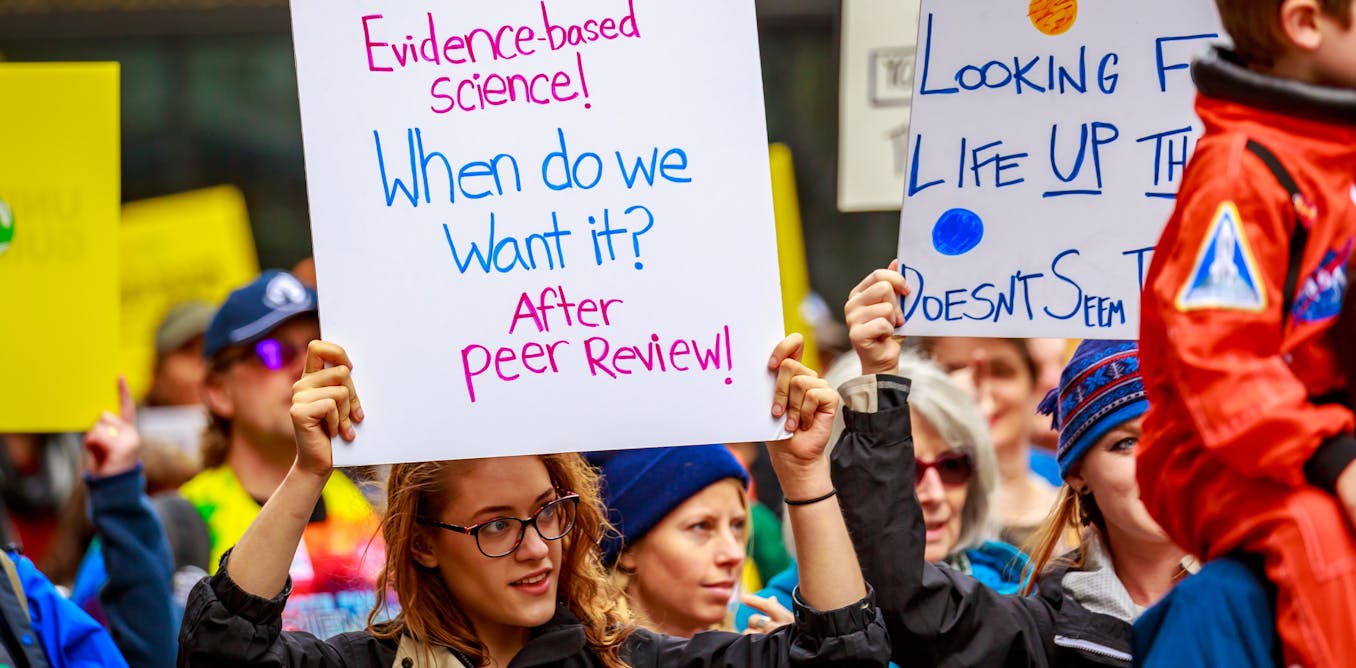
Yet these lone genius plots leave out nearly everything that makes science work. Namely, the rather boring and complex processes of accumulation and evaluation, from peer review to replication and endless disagreements, through which reliable knowledge emerges from a crowd of people and institutions.
Research also shows that people presented with academic research “in the making”, without definitive conclusions, often read any hesitations or equivocations as scientific weakness, rather than honesty.
Most people trust science without understanding its technicalities. This means trust can easily be attached to shared cultural markers of “scientificity”: technical vocabulary, charts, credentials, fancy equipment, numbers quoted to impressive precision. In other words, whoever displays the right cues sounds plausibly scientific.
Consider the example of Corrado Malanga, an Italian chemist who developed an elaborate theory of aliens harvesting human souls, and his collaborator Filippo Biondi, a radar researcher. Using satellite radar, the pair claimed in March 2025 to have discovered an elaborate hidden city up to two kilometres beneath the Khafre pyramid in Egypt.
Archaeologists quickly and widely dismissed these claims, in part because this kind of radar cannot see more than a few metres underground. Yet Biondi went on to present their “discovery” at length on The Joe Rogan Experience, one of the world’s most popular podcasts, in January 2026 – attracting many millions of views and listens to this widely disputed “scientific account”.
A recent analysis examined 8.7 million Twitter (now X) posts that shared supposedly fact-checked news stories. It found that references to scientific entities – through use of terms such as scientist, university or study – were associated with an increase in sharing. However, this was especially true of “low-veracity content, and when users lean politically to the right”.
Gary A Corcoran Arts/Shutterstock
More likely to endorse conspiracy theories
There are two threads intertwining here: a story about how science progresses, and the informal media where it mostly lives.
In our recent study, published in Current Psychology, we measured participants’ “genius mentality” (the propensity to believe that progress comes from exceptional individuals overturning consensus through intuition) and also their science media preference (whether they favoured podcasts and documentaries over expert-vetted sources).
We found people who scored higher on either metric were more likely to endorse conspiracy theories. These correlative effects were stronger than either education or political orientation, factors usually considered major drivers of such beliefs.
We also observed an interesting moderation effect: among people with little or even moderate trust in scientists, a high belief in the genius mentality markedly increased conspiracy belief. Among those who trusted scientists most, it made almost no difference.
From our research, we believe standard remedies, fact-checks and appeals to “trust the science” miss a deeper problem. They may correct claims one at a time, but leave untouched core beliefs (and misunderstandings) about how science works.
A more durable approach is to make the collective machinery visible: to explain why debate, peer review and the slow building of consensus, rather than individual intuition, are what make science reliable.
Some science education researchers argue that the goal should not be to turn everyone into a scientist, but a “competent outsider” – people who can correctly evaluate where knowledge comes from and how it has been produced.
We believe a school science education should not only introduce theories, but explain how the scientific community works on a daily basis. Children need to learn how knowledge emerges from many people cooperating and challenging each other within shared criteria – and that any consensus which survives this process is a strength, not groupthink.
Our ambition is to protect against future conspiracy theories before they emerge, rather than simply trying to correct the last one.