The NATO meeting in Turkey, fraught with tension, has concluded. United States President Donald Trump said at the start of the meeting in Ankara that he might not have attended had it not been hosted by President Recep Tayyip Erdoğan, whose authoritarianism Trump admires.
The media focus on Trump’s antipathy towards NATO reinforces the perception that the alliance is in trouble. While American ambivalence is a major issue for NATO, the other alliance members realize that, even without the U.S., it’s still important.
As Canadian Prime Minister Carney noted in his speech at Davos earlier this year, middle powers must work together in a multi-polar world.
Mark Carney’s Davos speech marks a major departure from Canada’s usual approach to the U.S.
Trump and NATO
Trump, during both his first and second terms, has made his hostility towards NATO clear. From Trump’s perspective, the U.S. provides a security guarantee to NATO member countries while receiving little in return.
The unwillingness of NATO countries to meet the alliance’s previous target of two per cent of GDP spending has made it easy for American critics to question the organization’s usefulness. Trump has even gone so far as to question Denmark’s ability to defend Greenland and said in Ankara, once again, that it should be handed over to the U.S.
This stance, understandably, has caused considerable consternation within Europe.
Trump’s decision to attack Iran has only exacerbated the tensions between the U.S. and NATO members. Despite not consulting NATO allies before his decision to attack Iran, Trump expected NATO’s support. European resentment over Trump’s attacks on European sovereignty not only caused NATO states to decline to support the U.S. — some countries also denied American access to bases that could support U.S. war operations.
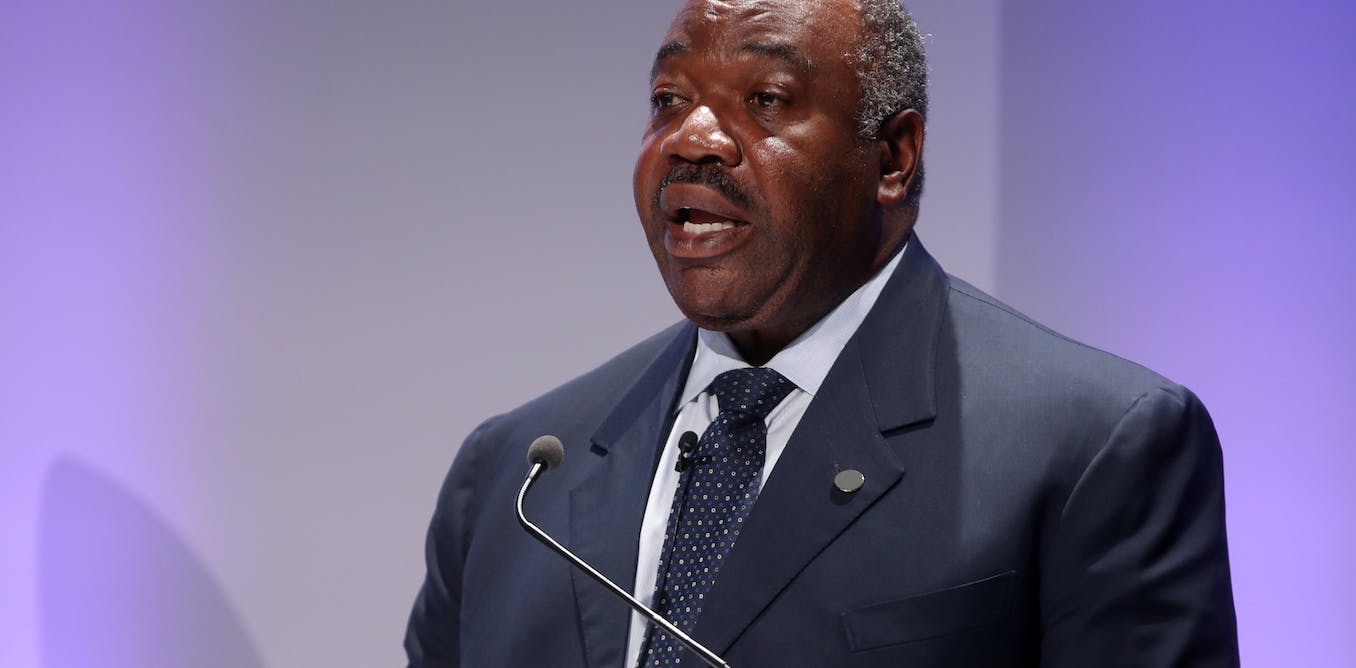
NATO Secretary General Mark Rutte, a noted “Trump whisperer,” has worked to appease the president. Nevertheless, as Trump’s initial statement in Ankara makes clear, relations between the U.S. and the rest of the alliance are poor.
These ongoing tensions are occurring at a moment of European need, with Russia escalating its attacks on Ukraine and creating fear within NATO. Even if the U.S. was willing to help, its ongoing war with Iran is depleting American capabilities.
NATO therefore must increase its capabilities in an unstable world.
Maximizing domestic resources
Beyond the U.S., NATO largely consists of small and middle powers. Although France and the United Kingdom possess both nuclear weapons and seats on the UN Security Council, their capabilities pale in comparison to other major powers, notably Russia and China.
If NATO members are to defend themselves without American support, they must first increase their domestic arms production.
Trump, inadvertently, has helped make this a possibility, but not to the economic benefit of the U.S, as he likely hoped. His relentless criticism about NATO members not meeting the alliance’s spending targets not only bolstered his “America First” political base, but the U.S. also presumed, as the world’s largest producer of armaments, that it would economically benefit from increased NATO spending on defence.
NATO countries, however, had other ideas.
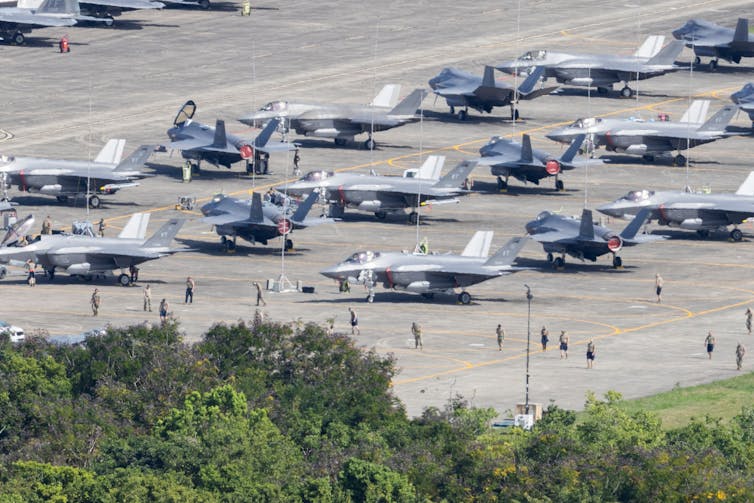
They’re moving away from their reliance on U.S. weapons and technology. Notable examples are governments looking to reduce, or outright cancel, their commitments to acquire American F-35s.
(AP Photo/Alejandro Granadillo)
NATO countries are also working to increase their domestic armament productions. For generations, NATO states have struggled to balance the alliance’s joint force requirements with the desire to protect domestic jobs, a tension that has ultimately restricted their weapons and munitions production.
In one notable instance, Canada recently announced that only Canadian companies would be able to tender offers for the Canadian Armed Forces’ light utility vehicle. This blocked two American companies from bidding on the project.
Boosting domestic arms production is only one way to strengthen NATO. Because war is ultimately a political act, NATO members require the political will to co-operate if they want their renewed focus on domestic industries to succeed.
Canada and the European Defence Fund
NATO’s inability to rely on the U.S. has, in fact, increased co-operation among non-American member states.
The European Defence Fund, although technically distinct from NATO, is allowing alliance members to work together on defence. The fund works to consolidate defence procurement, which has in the past been undermined by domestic pressures.
Nevertheless, it’s an important first step in creating an integrated European/NATO defence industry. The fact that Canada, a non-European country, is participating demonstrates the contemporary spirit of co-operation among NATO members.
Canada’s decision to purchase German-Norwegian submarines, rather than South Korea’s, is also an example of this new era of co-operation.
Rutte clearly hoped his announcement in Ankara about NATO countries increasing defence spending would appease Trump. But in reality, spending by NATO members shows they’re prioritizing the strategic needs of the alliance as a whole rather than simply giving in to political pressure.