Generative artificial intelligence (Gen AI) has been the most disruptive force to hit education in a long time, and educators are still absorbing the impact. My colleagues and I have had to reprogram our approaches and classroom assessments as Gen AI infiltrates every aspect of the academic setting.
I was not ready to have Gen AI affect my work with Holocaust education. I’ve come to believe that the risk of harmful outcomes using Gen AI to recreate images or scenes from the Holocaust outweigh the potential educational benefits. And I’m not alone.
In a 2024 report titled “AI and the Holocaust: rewriting history?”, UNESCO warned that AI could be used to fabricate realistic images or videos casting doubt on whether the Holocaust occurred — a phenomenon that could fuel greater antisemitism.
And in 2025, the Auschwitz-Birkenau Memorial Museum argued that using AI to generate fictional images of Auschwitz victims “is not a tribute — it is a profound act of disrespect to the memory of those who suffered and were murdered” and that it “undermines the integrity of historical truth.”
The ethics of duplication
The first time I encountered Gen AI in Holocaust education was in Joe Berlinger’s 2024 six-episode documentary, Hitler and the Nazis: Evil on Trial, where original news broadcast recordings of American journalist William L. Shirer were used to generate an approximation of his voice to read out the diaries he wrote when reporting from Nazi Germany.
Gen AI can be beneficial in certain circumstances. For example, the use of Shirer’s voice can help to better engage learners. With education and increased awareness as the main motives for employing Gen AI, the Jewish Children’s Museum in Brooklyn has used short videos to present Holocaust history to elementary school students in an age-appropriate manner.
(AP Photo/Markus Schreiber)
Algorithms and AI researchers Atay Kozlovski and Mykola Makhortykh assert in “Digital Dybbuks and Virtual Golems: The Ethics of Digital Duplicates in
Holocaust Testimony” that there is a human responsibility to interact with AI ethically. They state:
“This concern closely relates to the harm-risk mitigation condition, which demands identifying and evaluating potential risks and requires proactive steps to reduce them, whether through design or regulation.”
Local Journalism Initiative reporter Maggie Macintosh of the Prince Albert Herald reported in 2025 that “the Canadian Museum for Human Rights is using artificial intelligence to introduce visitors to lifelike avatars of aging survivors of the Holocaust who can hold real-time conversations with them.”
This would seem to suggest that Canada’s approach to contemporary Holocaust education embraces Gen AI. However, citing online content manipulated by Gen AI to depict Hitler spouting antisemitic tirades, but in English instead of German, has been described by many scholars as a “worrying trend.”
Clickbait, denial and the feed
The most common place to encounter Holocaust-related Gen AI is on social media. Although the average consumer is aware they must be critical of the images and videos they consume online, even the most savvy scrollers will can still absorb misinformation.
When people come across material related to the Holocaust on social media, sometimes it can be immediately obvious that it’s AI-generated. Some material might be expressly identified, but ambiguity could lead people to question the authenticity of not just the representation, but history itself.
Mindblown AI, a digital content creation platform that focuses on AI-generated historical storytelling, produced a short clip first posted to Facebook in 2021 that illustrates the short life of Anne Frank. The sequence depicts an AI approximation of Frank at various stages of her childhood leading up to her murder. It’s also set to ABBA’s catchy song “Lay All Your Love on Me.”
Mindblown AI published a similar video montage in 2024 about Irma Grese, a convicted war criminal and guard at concentration camps Ravensbrück, Auschwitz-Birkenau and Bergen-Belsen.
Female Nazi concentration camp guards: the true horror lies in their similarities to ourselves
Another, more alarming AI-generated video by History Fact Untold, a YouTube channel that publishes short-form historical trivia, details Grese’s violence and depravity. It shows a sexualized Grese walking through huddled masses of emaciated prisoners.
The content is not intentionally misleading; in fact the publisher is transparent about the use of Gen AI. But if a viewer fails to situate these videos within the realm of recreated historical representation rather than authentic documentation, there is room to interpret the Holocaust as less destructive than it was.
Gen AI photos depicting the Holocaust are arguably more problematic for audiences because high-quality renderings may appear quite convincing.
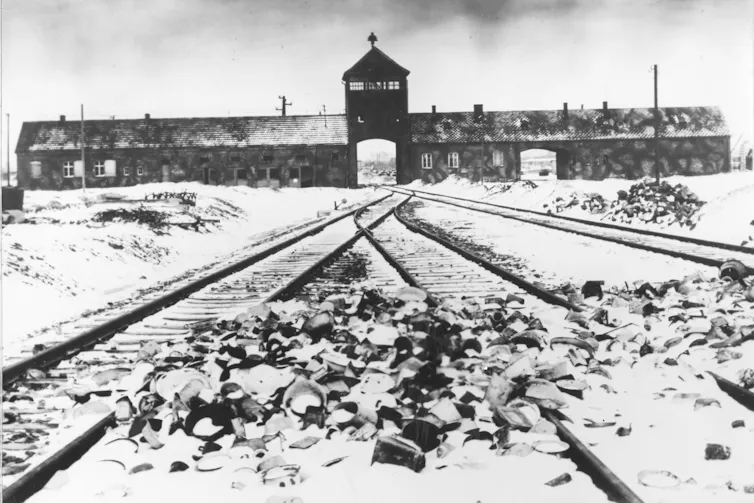
(AP Photo/Stanislaw Mucha)
DW News, a German news and current affairs channel, highlights one such image of an emaciated man playing the violin passionately while fellow prisoners are marched to his rhythm along their path to execution.
DW News analysis cites several visual indicators that reveal the image is fake: three non-linear strings on the violin, inaccuracies in attire including prisoners wearing belts and the number of fingers on background figures.
A teaching opportunity?
A student recently asked me whether using Gen AI to create images to accompany documented testimonies might be an effective way of engaging this generation of learners.
That’s an interesting point. We were, after all, discussing graphic literature and Holocaust memory narration. But at the end of the day, it’s very much a slippery slope.
In academia, we are trained to be vigilant. Instilling this same vigilance in future generations is becoming more critical than ever. We can accept this as an opportunity to actively engage AI-savvy young people in combating revisionism, distortion and denial.