Each of us tells a story about who we are, often tracing our identity back through an imagined line of ancestors. Though identity is fundamentally cultural, we tend to anchor it in biology – in the idea of a stable genetic inheritance passed down through generations.
Population genomics has exposed a history far more complex, dynamic and intertwined than we might wish to imagine. Even in a place such as Britain, long imagined as an island of deep and uninterrupted heritage, genetic data suggest a history marked by intense migration, mixture and cultural reinvention.
Two new studies have reinforced this picture, by analysing DNA from the skeletal remains of British individuals who lived during Roman and medieval times.
Prehistoric Britain witnessed periodic major migrations interspersed with smaller and more regular movements of peoples across what was then a contiguous landscape.
After about 6100BC, rising sea levels isolated Britain from mainland Europe, helping to promote later historical narratives of a population relatively isolated.
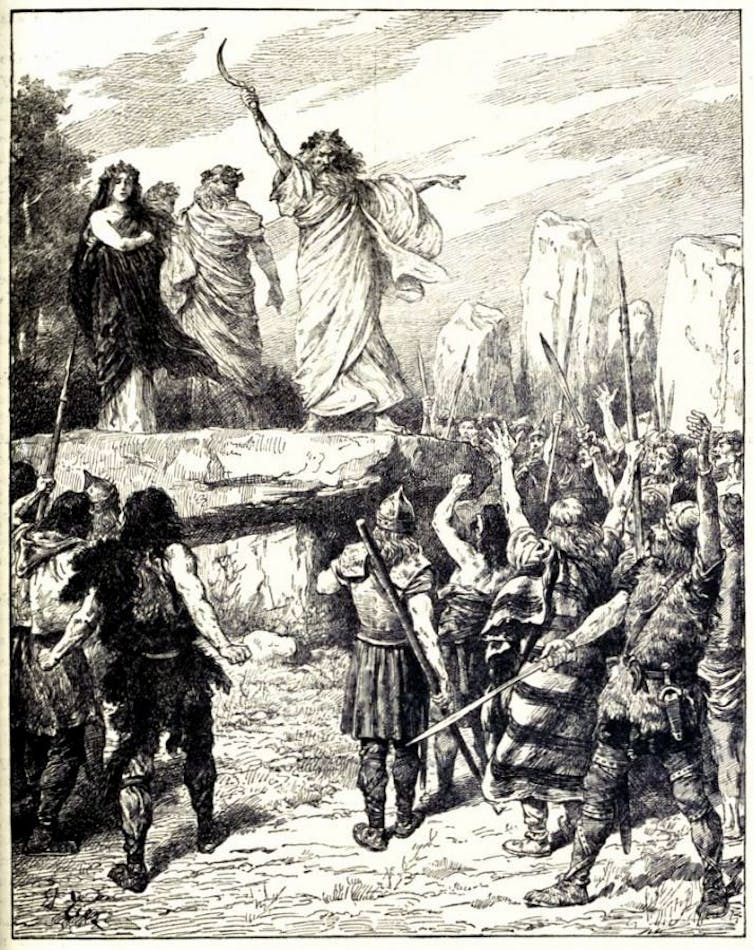
Yet even early observers recognised otherwise. Writing in the first century AD, the
Roman historian Tacitus noted the diversity of Britain’s tribes, suggesting their origins lay in Germany, Gaul and Iberia.
Edouard Zier
Such conclusions were drawn from physical, cultural and linguistic observations. Now it is testable, thanks to rapid advances in population genomics and ancient DNA sequencing, allowing direct ancestry reconstruction across demographic and political changes.
A major recent study by Marina Silva, from the Francis Crick Institute in London, and colleagues analysed more than 1,000 ancient genomes from across Britain during the first millennium AD.
The pre-print, which has not yet been published in a journal, asks one simple question: could the main historical events of Britain – the Roman occupation, Anglo-Saxon migration, the Viking Age and the Norman conquest – be detected in the genetic data of the populations that lived through these eras?
The answer was complicated. The Roman period, for all its political and cultural upheaval, left surprisingly little mark on the genetic structure of the wider population. About 80% of the individuals who lived during Roman times in Britain cluster almost exactly with those of the immediately preceding Iron Age, arguing for genetic continuity and no replacement. Even in urban centres where occupying Roman elites were most prevalent, the broader population retained overwhelmingly local ancestry.
In contrast, the early medieval period, from around 410AD (when Roman rule collapsed) to 1066AD, saw a substantial influx of new ancestry from across the North Sea. The researchers were able to detect this influx by comparing the British samples with genetic data from populations in other parts of north-west Europe. Continental ancestry associated with Anglo-Saxon migration appears in more than 70% of of the burials in southern “Anglo-Saxon” Britain.
Thus, migration was not just cultural but demographic on a scale sufficient to leave its imprint on the shape of population structure.
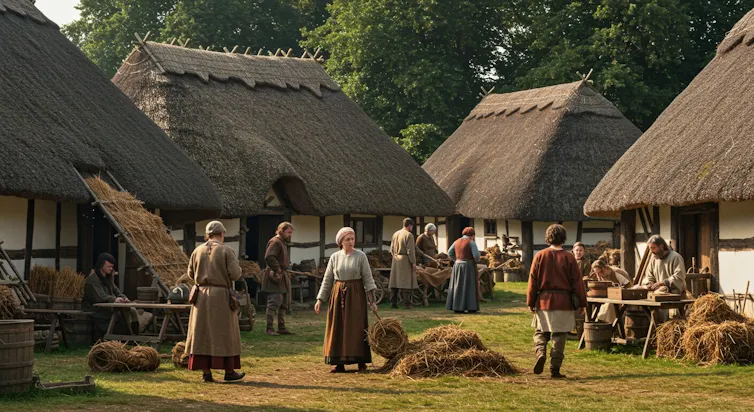
Yet even this transformation cannot be generalised. From about 700AD to 1000AD, further waves of continental influence appear in Britain, with the arrival of settlers from central Europe (seemingly from France and the Rhineland) and, to a lesser extent, the south of Europe. However, the Viking Age leaves a more uneven and regionally variable genetic signal than its historical prominence might suggest.
Shutterstock AI
While a Scandinavian component is clearly present in northern and eastern regions,
it is rarely of a magnitude comparable to that found in early medieval migrations.
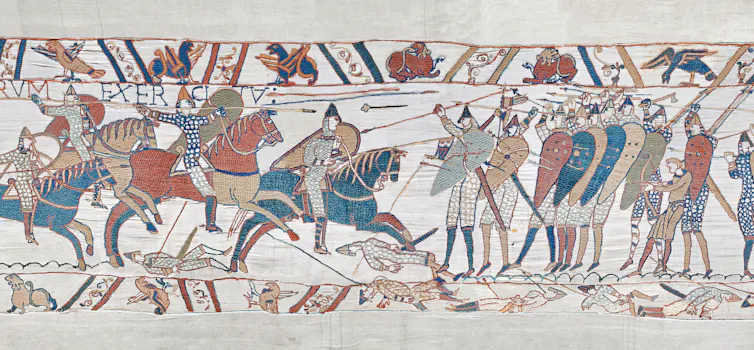
Most surprisingly, the Norman conquest of 1066 appears to have been largely an
elite process, leaving little detectable trace in the genomes of the common
population.
Genome-wide ancestry profiles straddle the date of the conquest, with
no hint of abrupt population replacement. Despite all its drama, the conquest seems, at the level of population genetics, to have involved elite replacement by relatively few individuals.
A second pre-print study provides a closer view of what this looked like on the ground. Focusing on a rural cemetery at Priory Orchard in Surrey, Flavio De Angelis, from Arizona State University in Tempe, and colleagues examined individuals buried across the centuries before and after the Norman conquest.
Again, the results are surprising: rather than any clear genetic break after 1066, both pre- and post-conquest burials fall within the same cluster, showing shared ancestry and no evidence for demographic turnover. The continuity is not just qualitative, but visible in the statistical similarity of ancestry components
across generations.
funkyfood London – Paul Williams
Instead, the community reflects a much longer history of interaction across the North Sea world. Its ancestry includes Anglo-Saxon-associated components, significant Scandinavian input dating to the Viking period, and smaller continental contributions.
Crucially, these elements are already present before the Norman arrival and persist
afterward. The Norman conquest, in genetic terms, is barely visible. What looks, on historical timelines, like a moment of dramatic rupture appears, at the level of the common individual, as a continuation. Genes tell the story of populations and detect localised impacts of migration, but they do not map neatly onto geopolitics.
Taken together, these studies point to a crucial distinction. Cultural and political change does not necessarily equate to demographic change. Britain’s history is neither one of uninterrupted continuity nor of repeated population replacement, but something more complex: long-term mixture punctuated by events that reshape institutions more than populations.
Some migrations – such as those of the early medieval period – left deep and
measurable genetic legacies. Others, despite their prominence in historical
narratives, left only faint traces. The discrepancy is striking: the scale of genetic change does not map neatly onto the scale of historical attention.
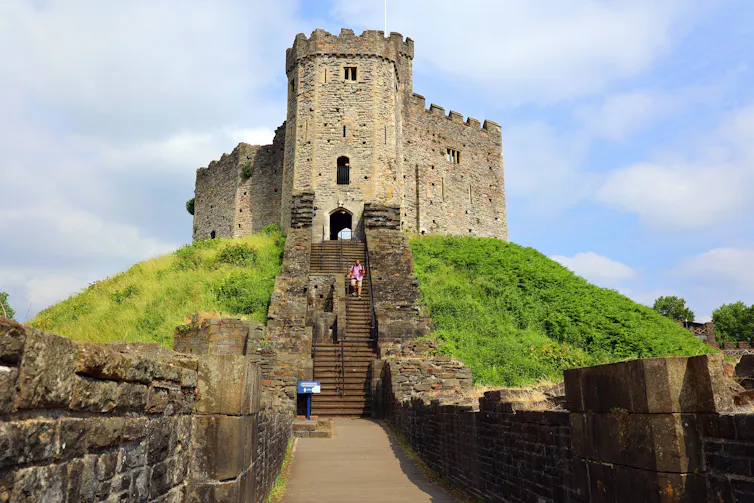
meunierd / Shutterstock
Modern genetic data reinforce this picture. Contemporary populations across the
British Isles do not form a single, uniform group. Instead, they cluster into
overlapping but distinct lineages reflecting different regional histories and varying degrees of past migration.
These patterns echo the ancient record, but they did not affect all regions equally. Wales and Ireland retain stronger continuity with earlier populations, while England shows clearer evidence of ancestry linked to early medieval migration from northern Europe. Scotland occupies an intermediate position, reflecting both long-term continuity and later Scandinavian influence.
Importantly, these differences are matters of degree, not kind. All populations of the British Isles share deep common ancestry overlaid by layers of migration whose
effects vary regionally. The structure we see today is the product of these layered
histories, not the survival of isolated or “pure” populations.
What emerges is not a story of rooted, bounded identities, but of continual
connection. British identity – like all identities – has been assembled over millennia through movement, interaction and adaptation.
Modern genomes do not simply tell us who we are; they preserve how we got here.
History does not make migration exceptional – it reveals it as the norm.