This article was first published in The Conversation UK’s World Affairs Briefing email. Sign up to receive weekly analysis of the latest developments in international relations, direct to your inbox.
Before he sent his war machine into Ukraine nearly four years ago, the Russian president, Vladimir Putin, talked of the need to rid the country of the “neo-Nazi cabal” which was holding it hostage and perpetrating a “genocide” of Russian speakers in eastern Ukraine.
Putin has doubled down on this regularly during the conflict, refusing to recognise Ukraine’s sitting president, Volodymyr Zelensky, as a legitimate negotiating partner and repeatedly calling for elections. He seems to have found a receptive ear in Donald Trump, who has repeated this call several times, usually after a phone chat with the Russian leader.
Now it’s being reported that Zelensky is planning for elections and a referendum on the Trump peace proposal, after the US insisted he do both by May 15 or lose US security guarantees. Zelensky has repeatedly pointed out that the Ukrainian constitution bars elections while martial law is in effect.
It’s easy to see why. As it stands, 20% of Ukraine’s territory is occupied by Russia. Do the people living on that land get a vote? How about the millions of displaced people – either in Ukraine or in the enforced diaspora? How to organise ballots for the hundreds of thousands of troops on active duty? The logistics are mind-boggling.
But it’s not just logistics. Stefan Wolff, an expert in international security at the University of Birmingham, and Tetyana Malyarenko of the University of Odesa present five reasons why holding a poll and referendum are a problem, given the present circumstances.
On the face of it, they argue, it feels as if the US president is once again coming up with a plan that favours Russia over Ukraine. But given the impossibility of organising these votes under the present circumstances, let alone providing for what would happen if, as seems likely, the people vote for Zelensky and against the Trump peace deal, this might actually play into the hands of Kyiv and its allies. Apart from anything else, the process will buy them some time to come up with a new strategy that will take into account Washington’s role as the most unreliable of partners.
Five reasons Trump’s plan for Ukrainian elections and a peace referendum will only prolong the war
Having said that, the phrase “if the people vote for Zelensky” is doing some heavy lifting here. The fact is that, four years into an existential struggle, Ukrainians are exhausted and morale is taking a beating in the face of relentless Russian bombardment. Zelensky, who was voted into power with 74% of the vote in 2019 on a platform of fighting corruption has seen some of his closest political allies embroiled in massive corruption scandals.
The fact that the most recent scandal, which saw his chief of staff resign, related to allegations of graft involving Ukraine’s biggest energy supplier was particularly damaging, given that many Ukrainians are living without power in the coldest winter in a decade, thanks to Russian bombing.
So Zelensky’s reelection is not a foregone conclusion. In fact, two of his close associates – Valerii Zaluzhnyi, the former chief of Ukraine’s armed forces and now ambassador to the US, and Kyrylo Budanov, who the Ukrainian president recently appointed as his chief of staff – would both be popular candidates. Neither has said they would run for office, but what politician ever does say that – until they do?
Jennifer Mathers, an expert in Russian and eastern European politics at Aberystwyth University, takes us through the possible challengers.
Ukraine: if elections are held this spring, who might be the next president?
The Epstein files
To Washington, where members of Congress have started to sift through some of the 3 million documents from the “Epstein files” released by the Department of Justice at the end of January. Observers have commented that, unlike in Europe, where the fallout has included considerable political splashback for some important people, reaction in the US – so far at least – has been comparatively muted.
Of course, the unredacted files have only just been made available to US lawmakers. So it’s hard to gauge how people are going to react when big names begin to be linked with sleazy acts – whether that might be sexual, political or business-related.
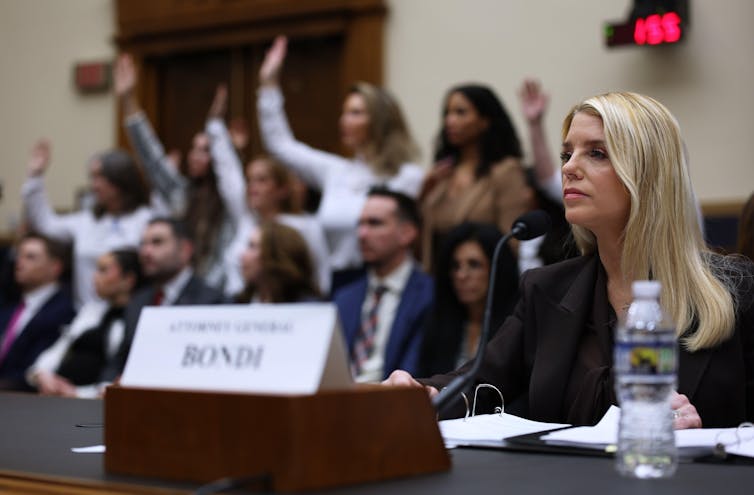
Releasing the files is a gamble for the US Department of Justice and the attorney-general, Pam Bondi, writes Katie Pruszynski, an analyst of US politics at the University of Sheffield. While the potential for scandal is huge, the US public is having to digest so many other stories. This year alone, the US has conducted a raid on Venezuela and abducted its president. There have been threats against Greenland and Canada. The activities of ICE and other immigration agencies in US cities, particularly in Minneapolis where two people have been shot dead, have also rightly dominated headlines.
AP Photo/Tom Brenner
On top of that, millions of people have seen their health insurance premiums skyrocket after the subsidies established under Obamacare lapsed on January 1. People may simply not have the mental bandwidth to take it all in.
But all this might change once the unredacted files are made public. The key thing Republicans will be hoping for is that any furore surrounding the Epstein scandal will die down before the midterm elections in November.
Meanwhile, as Pruszynski notes, Epstein’s victims – many of whose names were not redacted, despite the US Congress passing a law to that effect – are still waiting for justice.
Epstein files: why the Trump administration is taking a big gamble by releasing millions of documents
The release of victims’ names raises an interesting side issue: who decides what information is released and what is redacted? Matthew Mokhefi-Ashton explains the competing legal principles which balance the public’s right to know with people’s right to privacy.
Epstein files: who decides what information is released to the public?
Hard times in Havana
When the US secretary of state, Marco Rubio, was taking questions after the raid on Caracas on January 3, he appeared to relish the idea of the US turning its attention to Cuba, commenting that: “If I lived in Havana, and I was in the government, I’d be concerned – at least a little bit.” His boss appeared to rule out direct intervention, at least for now, saying: “Cuba is ready to fall … I don’t think we need any action. Looks like it’s going down. It’s going down for the count.”
He may not be far off the mark, given that Cuba is fast running out of oil. The situation there is so parlous that at least one air carrier, Air Canada, has cancelled all flights to Cuba because it can’t be sure that its aircraft would be able to refuel. This is a disaster. Cuba is heavily dependent on tourism for the foreign currency is so desperately needs.
Since Trump returned to power a year ago, the US has made it nigh on impossible for Cuba to source enough fuel to meet its energy needs. Now he is essentially saying the communist government of Miguel Díaz-Canel must negotiate a deal (on American terms) or else.
But whatever Rubio, who has nursed a career-long obsession with his parents’ home country of Cuba, may want to see, achieving regime change on the Caribbean island will not be easy, writes Nicolas Forsans of University of Essex. Forsans sketches out what a US deal with Cuba that falls short of replacing the government might look like.
The US is starving Cuba of fuel – here’s what a deal between them could look like

Sign up to receive our weekly World Affairs Briefing newsletter from The Conversation UK. Every Thursday we’ll bring you expert analysis of the big stories in international relations.