Donald Trump delivered an ultimatum to Iran at the first board of peace meeting in Washington on February 19. He told Tehran to reach a “meaningful” deal with the US within ten to 15 days or “really bad things” will happen. White House press secretary Karoline Leavitt had earlier said there are many arguments for taking military action in Iran.
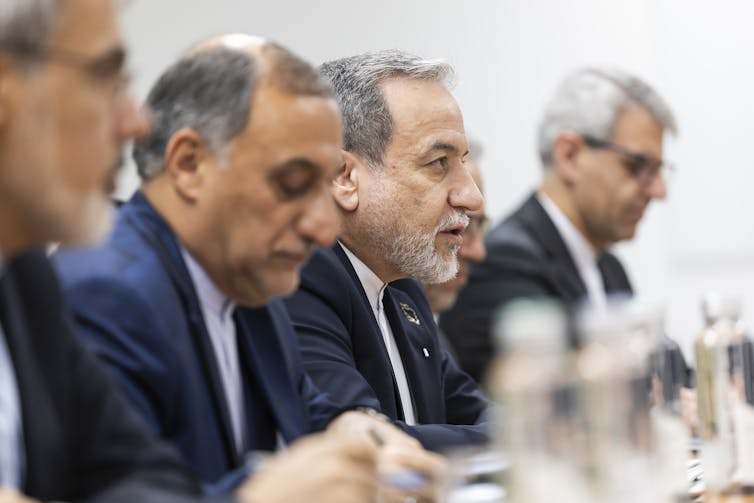
These comments came as reports indicated that the latest round of indirect talks between the two countries in Switzerland on February 17 had made at least some headway. Iran’s foreign minister, Abbas Araghchi, emerged from the negotiations hailing what he saw as “good progress”. He added that the US and Iran had reached an understanding on “guiding principles”.
The assessment of US representatives was less positive. Despite acknowledging that “in some ways” the talks went well, US vice-president J.D. Vance said Iran was refusing to acknowledge core US demands. The US wants Iran to dismantle its nuclear programme completely, reduce the number and range of its ballistic missiles and end its support for regional proxy groups.
Following the talks, the US has continued to reinforce its military presence in the Middle East. Cargo planes, fighter jets, refuelling tankers and an aircraft carrier have been moved to the region, with a second aircraft carrier expected to arrive soon. According to the New York Times, the buildup of US forces in the Middle East is now sufficient for Trump to order military action at any moment.
Iran appears to be gearing up for a confrontation. Its military held joint drills with Russia on February 19, days after the Strait of Hormuz was closed temporarily as Iran carried out live-fire exercises. And while emphasising that it “neither seeks tension nor war”, Iran has told the UN that if it were attacked it would consider “all bases, facilities and assets of the hostile force” in the region as “legitimate targets”.
Cyril Zingaro / EPA
These developments come less than a week after hundreds of thousands of people, largely from the Iranian diaspora, demonstrated in cities worldwide. They did so in solidarity with protesters who took to the streets of Iran in January to demand regime change.
In late December, protests that began over worsening economic conditions quickly spread nationwide in one of the most serious threats to Iran’s political establishment since the Woman, Life, Freedom protest movement of 2022. That protest wave began after the death of a 22-year-old women called Mahsa Amini in police custody.
This time round, the Iranian authorities imposed a near-total internet shutdown, creating a nationwide communications blackout in an effort to suppress the unrest. Human rights groups say thousands of people were killed, while many more were injured, detained or remain missing, in what was one of the most severe crackdowns in Iran’s modern history.
According to local police, around 250,000 people rallied on February 14 in the German city of Munich alone, where world leaders had gathered for Europe’s biggest security conference. Many of those in attendance waved flags bearing the lion and sun emblem of Iran that was used before the Islamic revolution in 1979 ended the Pahlavi dynasty.
Israeli and American flags were also visible at many of the rallies. This has widely been seen as a call for foreign intervention against Iran’s clerical leadership. Trump had raised the prospect of US military action during the unrest, urging the Iranian people to continue protesting and telling them that help was “on its way”. Such action now appears likely.
Brink of war
Iran’s fate is hanging in the balance. The deployment of US military assets to the Middle East suggests Trump may be preparing for imminent military action. However, despite making no secret of his desire to topple the Iranian regime, there is still a chance that Trump settles for a diplomatic agreement with the country’s leadership.
Iranian opposition voices, including exiled crown prince Reza Pahlavi, say such a deal would only prolong the survival of the Islamic Republic rather than address the demands of people in Iran for regime change. In an interview with American political commentator Glenn Beck on February 11, Pahlavi called the negotiations between the US and Iran “another slap in the face of the Iranian people”.
But the prospects that any deal will be reached look slim. The US and Iran remain in fundamental disagreement over Tehran’s nuclear programme and have been unable to reach a deal since the Trump administration withdrew the US from a previous agreement in 2018 that had been negotiated by the Obama administration.
Many people, including the US vice-president, are also sceptical that Iran’s authorities will budge on additional US demands around ballistic missiles and proxy groups like Hamas and Hezbollah – whether or not they are threatened with military action.
Iran’s future is murky. But one thing is for certain: with war or without war, the Iranian people have started a revolution that has extended beyond their country’s borders.