A new study of carbon-based molecules in a Martian rock offers new hints about the possibility that the red planet once hosted life.
The researchers considered a range of possible processes that could have produced the molecules they found. They argue that high concentrations of large organic (carbon-based) compounds found in the rock cannot be fully explained by the non-biological processes they examined.
The team members say it is therefore possible that the organics were produced by living organisms. It is also feasible that molecules made by hydrothermal processes – where water is heated to high temperatures underground – also contributed to the organics found in the rock.
The scientists also believe that some of the organic compounds came from fatty acids, which are found in the cell walls of living organisms.
The complexity of the newly detected molecules is strikingly distinct. They require more complex methods for production, which helps scientists narrow down their source.
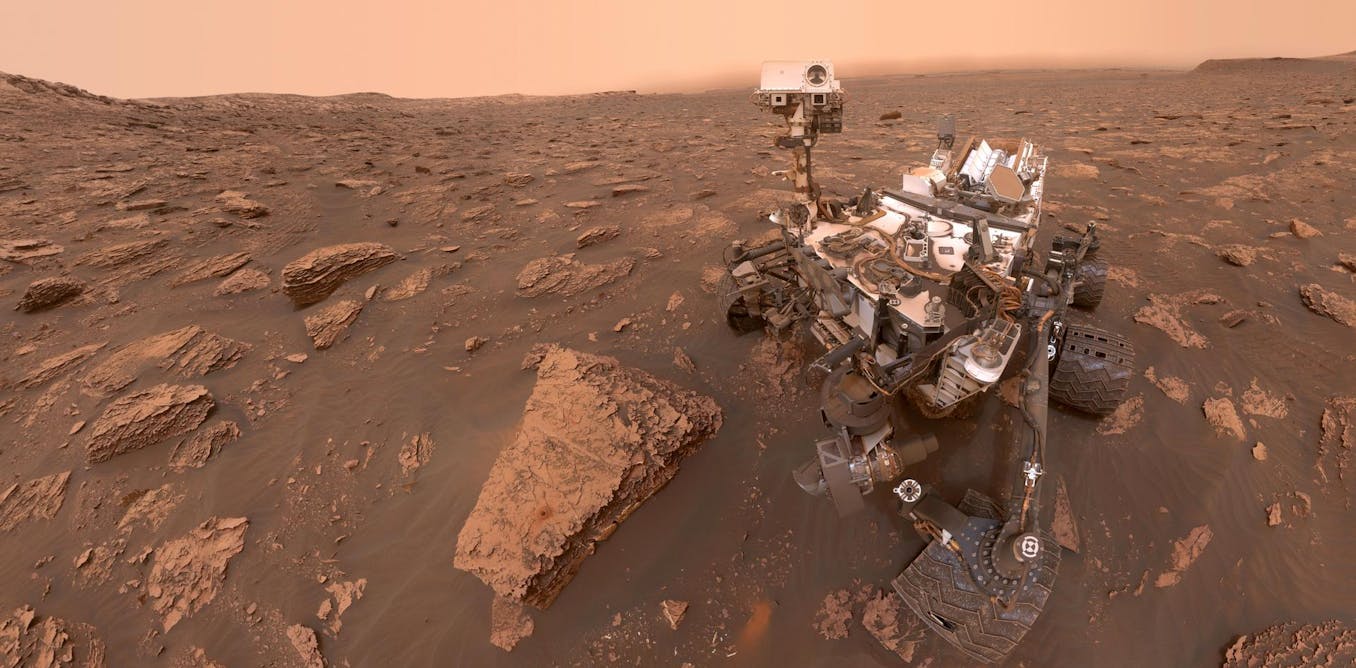
The discovery of the molecules was made with Nasa’s Curiosity rover, which examined a Martian rock named Cumberland. This is a sedimentary rock, meaning it was probably built up in layers in the presence of water billions of years ago. Curiosity has been exploring a site called Gale Crater on Mars since 2012.
The molecules include long chain alkanes in the form of decane (C₁₀H₂₂), undecane (C₁₁H₂₄), and dodencane (C₁₂H₂₆), much larger molecules than previously identified on Mars.
These measurements come from a pyrolysis experiment – where samples are heated to release gases that can then be analysed. This experiment broke down even larger molecules, and the assumption, from well-known chemistry, is that these may have been derived from carboxylic acids, or fatty acids. These are the kinds of compounds we recognise from our food.
The molecules were reported in a separate paper from March 2025. This new study, in the journal Astrobiology, considers the various ways they could have been made, both biological and non-biological.
Nasa/JPL/MSSS
The discovery of organics on Mars is critical to our understanding of whether the planet could have supported life (and whether it could today). Organic matter refers to molecules containing a bond between carbon and hydrogen. These comprise the essential building blocks for life as we know it.
The critical line of reasoning in the new paper is that because these long chains will break down under the ionising radiation in the harsh Martian environment (a combination of ultraviolet radiation from the Sun, heavier charged particles that don’t make it through Earth’s magnetic field, and cosmic radiation), the actual quantity of the carboxylic acids that we are measuring now must have been hundreds of times higher in the past.
Today, these molecules are present at 30–50 parts-per-billion in the rock. But the authors estimate this could have been around 120–7,700 parts-per-million before ionising radiation exposure.
Read more:
Signs of ancient life may have been found in Martian rock – new study
The authors examined several possible, but non-biological, sources for these fatty acids, such as delivery by interplanetary dust and meteorites, organic hazes in the ancient Martian atmosphere, and the act of serpentinisation – a geological process known to have occurred on Mars involving high heat and abundant liquid water.
The authors point out potential limitations with some of these processes that may make them less likely as sources for the organic molecules. For example, these limitations may relate to what we know about the ratio of simple organics, like methane, to the amount of CO₂ in the early Martian atmosphere, or where reactions like serpentinisation need to take place (underground) and how this matter could be transported to the surface.
Therefore, the authors argue, it is plausible that these carboxylic or fatty acids have a biological origin and may be remnants of an ancient, early Martian biosphere. They concede in their closing paragraph extraordinary claims require extraordinary evidence, as the scientist and author Carl Sagan once said, and downplay any attempt to claim evidence of life without intense scrutiny. However, it sets an optimistic tone for future projects – and there will be a busy future on Mars.
In September 2025, Nasa made a similar announcement using results from the Perseverance rover. They reported organic carbon-bearing mudstones that appeared to have participated in low temperature chemical reactions after they were deposited.
The researchers behind this study also looked at a variety of ways that the reactions could have taken place and were unable to explain them using known non-biological processes. The results hinted at the possible presence of microbial activity on Mars billions of years ago.
However, it will be impossible to say for sure whether the red planet hosted life until Martian rocks are delivered to Earth for analysis in laboratories. The findings published in September 2025 were largely seen as a rallying cry for the Mars Sample Return mission. This will gather up samples collected by the Perseverance rover and send them to our planet for examination.
Unfortunately, Mars Sample Return was effectively cancelled last month after years of being under-funded. Despite this, there remain big things ahead. The European Space Agency will send its Rosalind Franklin rover to Mars in 2028, featuring a drill that will search for signs of life up to two metres underground.
In 2026, Japan will attempt to retrieve a piece of the Martian moon Phobos with its Martian Moons Exploration mission. At the same time frame, follow-up missions from China and India are taking shape, with China also attempting to retrieve a sample from the surface.