Militaries play a major role in the politics of many countries. They determine whether elections can occur and who can compete. From Egypt to Pakistan and Myanmar to Uganda, the military is often the most important powerholder.
In parallel, violent non-state actors – including criminal networks, terrorist groups and paramilitaries – have proliferated over the last two decades.
To maintain their influence and finance their operations, militaries and violent non-state actors often become heavily involved in both legal and illicit business activities. Studies of their economic activities often focus on their role in extracting natural resources like gold, oil and timber.
Their involvement in agricultural and food systems is less well understood.
This is important to study since many of the world’s most fragile countries are highly dependent on agriculture for economic growth. We drew on our multidisciplinary expertise in food systems and agriculture to help fill this gap. Our recently published article looked at the role of the military and paramilitary in Sudan’s agrifood system just prior to the outbreak of the current war.
The two main belligerents in the country’s devastating conflict – the Sudanese Armed Forces and the paramilitary Rapid Support Forces (RSF) – have built extensive empires. They have investments in land, food processing and agricultural trade.
Our study mapped the companies that the army and RSF have in the agrifood system. It also analysed the different strategies they have used to gain profit in different agricultural sectors, especially livestock, wheat, gum arabic and horticulture.
We found that the army and RSF used a range of strategies. For example, they dominated in low-complexity value chains with limited private sector activity, such as livestock trade or raw gum arabic trade.
In these sectors, both forces focused on extracting profits to fund their operations without investing in upgrading.
We also found that they were less active in more technically complex sectors, like gum arabic spray drying, cotton ginning, dairy or finished sesame.
Economic competition between the Sudanese army and the paramilitary RSF was a major factor in the outbreak of the April 2023 war. Identifying these strategies expands insights into the political and economic roots of large-scale conflict.
The study
Our study drew on interviews with over 50 Sudanese key informants with extensive experience in major agro-food companies, the agricultural and livestock sectors, the previous civilian-led government, and within transparency and governance non-governmental organisations.
We brought together two strands of research that are rarely combined. These are studies on agricultural value chain upgrading – which refers to improving the quality, efficiency and value of agricultural products – and military commercialism.
The value chains literature highlights that more sophisticated products – such as speciality coffee and cocoa, wine, cheeses, edible oils, meats and poultry, and horticulture – need higher levels of expertise and equipment. This in turn requires larger outlays of investment.
Military commercialism studies underscore that armed actors have short time horizons because they seek off-budget profits to purchase weapons and machinery, and to retain the support of rank-and-file soldiers.
We therefore argue that the value chains in which armed actors engage – and the degree to which they invest in them – is based on how quickly profits can be extracted. This decision depends on two factors:
the level of technical complexity to generate profits from the agricultural product
the extent of existing private sector involvement in the value chain.
The strategies
We identified four distinct strategies armed actors use in agrifood value chains in Sudan.
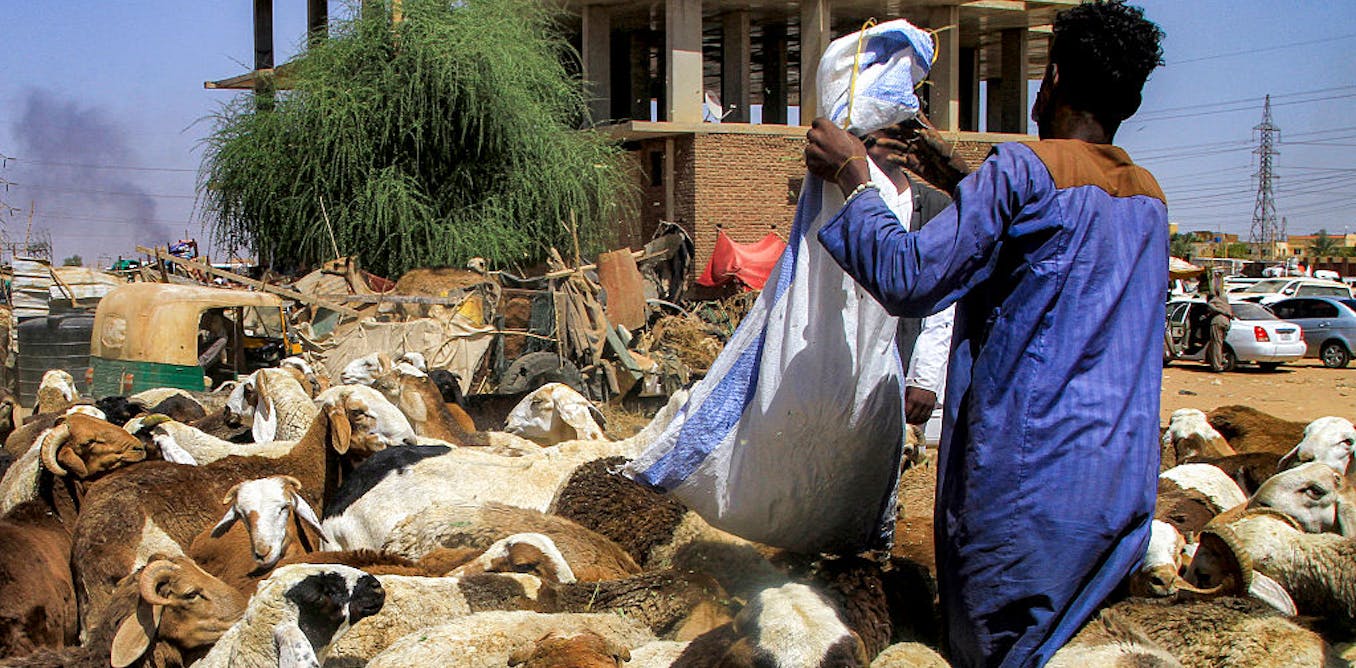
1. Exclusive capture and rent extraction. This is most clearly illustrated by the livestock trade. This is one of Sudan’s biggest export earners after gold. However, some countries, such as Saudi Arabia, have declared import bans on Sudanese livestock due to non-compliance with sanitary and phytosanitary standards, and vaccination protocols. These require investments in traceability systems and quarantine practices. Despite such restrictions, the Sudanese army and RSF capture significant profit from the trade. The army, for instance, benefits from demand from the Egyptian military. The RSF leverages demand from Gulf countries and close cultural ties with pastoralist communities in Darfur and Kordofan where a significant share of livestock trade originates.
2. Biased competition through licensing and quota allocations. A case in point is the processing of wheat into flour for Sudan’s most important staple good, bread. Flour processing in Sudan has had several prominent private sector operators since the mid-1990s when wheat milling was liberalised. Almost two decades later, Sudan’s intelligence services began operating Seen Milling Company. This was transferred to the army after the 2019 ouster of Omar Al-Bashir. Seen Milling Company benefited from several sets of distortions that skewed the playing field against the private sector. These include preferential exchange rates and import subsidies that almost put the private sector out of business.
3. Concede to private competitors when value addition is too complex. Gum arabic from Sudan accounts for approximately 70% of global trade. The product is most profitable when it is transformed through a highly complex technique known as spray drying. It is then used in the pharmaceutical industry, textiles and in food and beverages. Traditionally two French companies spray dried most of Sudan’s raw gum arabic. But in 2017 one of Sudan’s largest private sector agro-processing firms, DAL, established its own spray drying facility and began exporting all over the world. While the army attempted to mimic this approach via one of its companies, Green Zone, it lacked the technology and technical skills. The army ultimately abandoned the venture.
4. Innovation when profit potential is high and the private sector is absent. This is best illustrated in the horticultural sector. The army’s Zadna corporation, which is currently sanctioned by the US and the European Union, became a leader in horticulture research and development. The horticultural sector offers large opportunities for domestic growth and export potential. However, it has previously been hindered by underinvestment and minimal private sector involvement. Zadna entered the sector by establishing a major tissue culture lab and large nursery for preparing high-quality seedlings for many horticulture products. It also conducted research on new seed varieties, fruit and vegetable drying, and waste management.
Why the findings matter
By showing the diverse strategies that armed actors might employ, we hope to advance discussions about the political economy of food system transformations, with a focus on fragile contexts.
We show that armed actors’ strategies are sometimes very extractive (for instance, livestock) and sometimes more progressive (for instance, horticulture).
For private sector companies operating in such contexts, one of the main findings from our study is that shifting to more complex upgrading that requires greater technical skills can often mitigate the loss of market access to armed actors. We found this in dairy and gum arabic spray drying, for instance.
Our research underscores the importance of understanding the political economy incentives that drive large-scale conflict. Peace efforts in Sudan cannot just be about negotiations over ceasefire conditions and reconciliation processes. They also need to address who retains access to the country’s valuable resources and at what cost.