


As today’s parents navigate the challenges of raising a child, many are turning to online spaces where fellow parents share their experiences. One such space is the r/Parenting community on Reddit. It is the largest community for parents on the site, with more than 8 million members as of November 2025.
To better understand the discussions about parenting that take place online, we examined six months of user submissions and comments on the r/Parenting subreddit. We also conducted a survey of U.S. parents with a child age 12 or younger to ask about their experiences with online parenting communities.
Here are some of the main findings:
Posts on r/Parenting frequently mention kids’ technology use and the division of parental duties.
Reddit users can write posts (also called “submissions”) that other users are able to read and respond to. Posts on the r/Parenting subreddit cover a wide range of concerns. For this study, we focused on those mentioning three key issues:
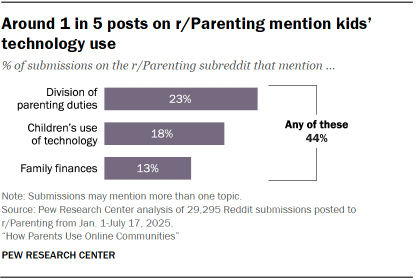
- 23% of all posts mentioned the division of child care responsibilities between parents.
- 18% mentioned kids’ technology use.
- 13% mentioned family finances or the financial challenges of raising a child.
In total, 44% of all posts on r/Parenting mentioned one or more of these issues.
Parents often turn to these online communities in times of distress.
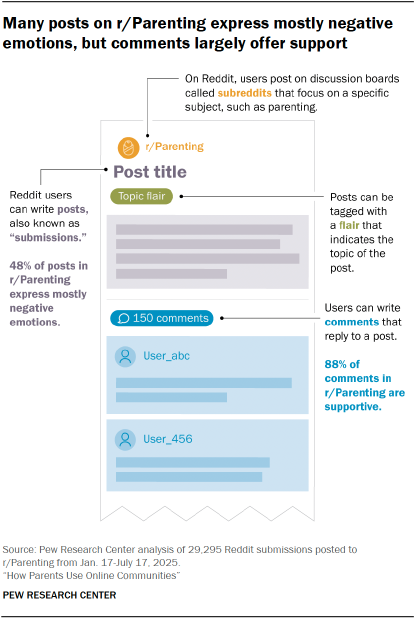
Some 48% of all posts written during our six-month study period expressed mostly negative emotions, often describing concerns or seeking advice for a stressful dilemma. Just 5% of posts expressed mainly positive emotions, such as those celebrating a developmental milestone or recounting a success story.
Of the topics we looked at, posts mentioning the division of child care duties between parents were especially likely to be framed in a negative way.
Commenters are there to help.
Despite longstanding advice to “never read the comments,” we found that the comments responding to these Reddit posts are overwhelmingly supportive and contribute usefully to discussions.
A majority of the accounts that commented during these six months did so multiple times. This highlights how online spaces for parents can provide a dedicated and supportive community to reach out to in the face of specific challenges.
Moms are especially likely to look online for advice from other parents.
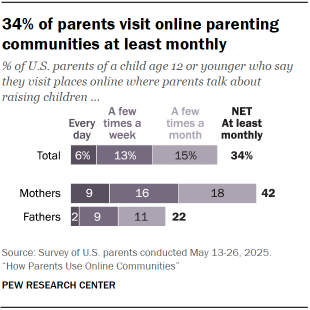
In our survey of U.S. parents, 34% say they visit places online where other parents talk about their experiences raising children at least monthly. And 42% of mothers say they do this regularly, nearly double the share among fathers (22%).
An analysis of the r/Parenting subreddit
To learn more about parenting discussions taking place online, we analyzed all the user submissions and comments posted to the r/Parenting subreddit from January to July 2025. This amounted to around 30,000 posts and 850,000 comments in total.
Issues people discuss on r/Parenting
Discussions on r/Parenting address a wide range of topics. Posters frequently ask for advice, share recent parenting experiences or pose questions to the Reddit community. For this analysis, we looked for three specific topics that appear frequently in user submissions:
- Division of child care responsibilities between parents
- Children’s use of technology
- Financial challenges of raising children
In total, 44% of all posts published during our six-month study period mention one or more of these issues, with division of parenting responsibilities the most common. Below is a more in-depth look at how often and in what contexts these topics are discussed. (Appendix A contains a more detailed list of the terms that distinguish each topic.)
Division of parenting duties (mentioned in 23% of all posts): Frequent themes in these posts include stay-at-home parenthood, co-parenting between separated parents and balancing domestic work with a career outside the home.
For example, the following excerpts are adapted from r/Parenting posts mentioning shared parenting responsibilities.
“I’m upset that I have to be available 24/7 even when my husband is home. I just feel like I get no break. Am I overreacting? How should I approach this?”
“I am so burnt out. … I work full time, I do all the cooking, and both kids are more attached to me. I’m so drained and I’m cranky all the time. Is anyone else going through this? Any advice?”
Children’s technology use (18% of all posts): Posts mentioning this topic are distinguished by discussions of devices and screen time, TV, social media like YouTube and TikTok, and popular video games for young people like Minecraft or Roblox. Read our October 2025 study for survey findings on how parents manage screen time for their kids.
The following excerpts are adapted from r/Parenting posts mentioning children’s technology use.
“My 9-year-old keeps telling me he’s the only one in class without an iPhone. I found ways around parental controls when I was young, so I want to wait until he is in middle school. But I do feel bad that he feels left out. If your 9-year-old does have a phone, what type and how often do you check it? What types of controls do you have on it?”
“My son just lounges in his room all day long in his pajamas. He will come down to eat, then go back up. It’s like he’s not even part of the family because we hardly see him. … There are no interests stronger than his phone. He just wants to lay in bed and chat with his friends and check his online football team.”
Financial challenges of parenthood and raising children (13% of all posts): Common themes in these posts include general discussions of budgeting, costs and affordability, as well as how to navigate significant expenses like rent, tuition, mortgages and paying off debts. Read our 2022 study for more on the economic challenges faced by U.S. parents.
The following excerpts are adapted from r/Parenting posts mentioning the financial challenges of raising children.
“Rich parents, please think of families with lesser means when you’re considering how generous the tooth fairy should be. My kid’s speech therapy costs are already bankrupting me. $50 per tooth is setting everyone up for failure.”
“Day care is not within our budget, so my wife staying home and me working is a better solution for the kids and our wallets. … But she is stressed about her internal self-worth and how to function with no regular job.”
Positive and negative emotions in posts on r/Parenting
When we examined the emotions expressed in r/Parenting posts, we found that 48% convey negative emotions like anger, sadness, disgust, stress or fear.
A similar share of posts express neutral or mixed emotions. This includes posts that do not clearly express any emotions, as well as those with a roughly even mix of positive and negative emotions.
Posts that contain mainly positive emotions like gratitude, pride, joy or amusement are much rarer. Just 5% of posts express these positive sentiments.
Certain posts are more likely to be negative than others.
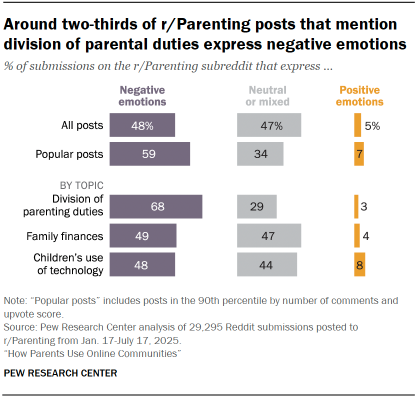
For instance, 59% of the most popular posts (those with the most comments and upvotes) express primarily negative emotions.
And of the topics we measured, posts that mention the division of parenting responsibilities are by far the most negative. Around two-thirds of all posts mentioning this topic (68%) express negative emotions. For the other topics we looked at, that share is roughly half.
Support and criticism in r/Parenting comments
Although negative emotions are quite common in r/Parenting posts, comments in direct reply to these posts are overwhelmingly supportive.
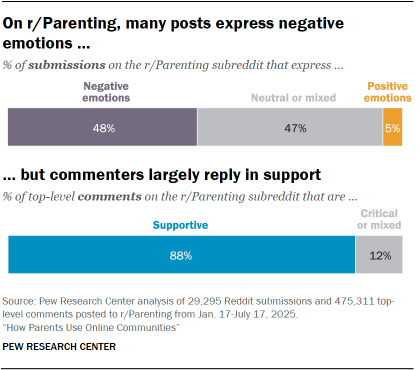
Of the top-level comments that we collected over this six-month period – that is, those replying directly to the original post and not to another comment – 88% offered support for the person who made the original post. These include comments offering helpful advice, responding thoughtfully to a question posed in the original post, or otherwise contributing positively to the community discussion.
By contrast, just 12% of comments are not supportive of the original post or its author. These include comments that are difficult to interpret or irrelevant to the original post, those that provide a mix of advice and criticism, and those that are outright critical.
Other findings about posting and commenting behavior on r/Parenting
Our analysis uncovered several other findings that shed light on the use of online parenting communities.
Users on r/Parenting comment more often than they post. During our six-month study period, over 110,000 unique accounts authored a post or a comment on r/Parenting. The vast majority of these accounts (94%) left a comment, while 20% wrote a post.
Those who comment tend to do so repeatedly, with 59% of commenters writing multiple comments over the six months. (By comparison, 16% of post authors submitted multiple times in the same period.) Commenting is highly concentrated among a small share of users: The top 5% of commenters produced around half (52%) of all comments.
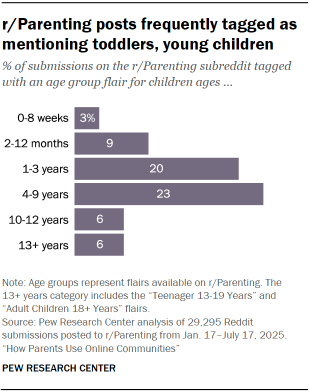
Toddlers and young children are a frequent subject of discussion. On Reddit, users submitting a post can tag that post with a “flair” to indicate the topic of discussion. Among the posts tagged with a child age group in r/Parenting, 20% are tagged “Toddler 1-3 years,” and a similar share (23%) are tagged “Child 4-9 years.”
Posts on r/Parenting often get deleted or removed. As of October 2025, just 62% of the posts we collected were still accessible on the site. Some 29% were deleted by the post author, while 9% were removed by the subreddit moderators.
Survey findings: How U.S. parents use and view online parenting communities
Online parenting communities can take many forms. To learn more about the average parent’s experience, we surveyed U.S. parents with at least one child age 12 or younger about online spaces where parents talk about raising children. We asked them to think about their experiences with platforms like social media and online discussion forums.
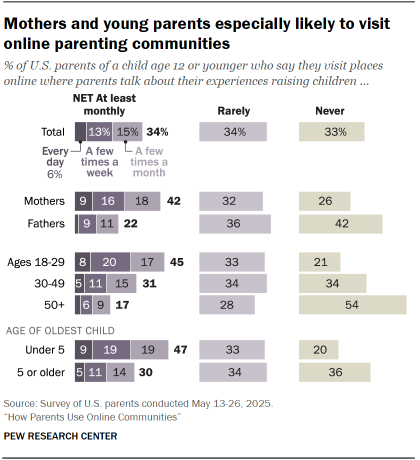
Our survey finds that 34% of parents say they visit online parenting communities at least monthly. Another 34% say they rarely visit them, while 33% say they never do.
Majorities of parents in nearly every major demographic group say they visit online parenting communities at least rarely. And certain groups are especially likely to do so at least monthly:
- Mothers: 42% of mothers and 22% of fathers regularly do this, a difference of 20 percentage points.
- Younger parents: 45% of parents ages 18 to 29 visit these sites regularly. By comparison, 31% of parents ages 30 to 49 visit online parenting communities regularly, as do just 17% of parents ages 50 and older.
- Newer parents: Almost half (47%) of parents whose oldest child is under 5 visit these communities regularly.
How parents feel about online parenting communities
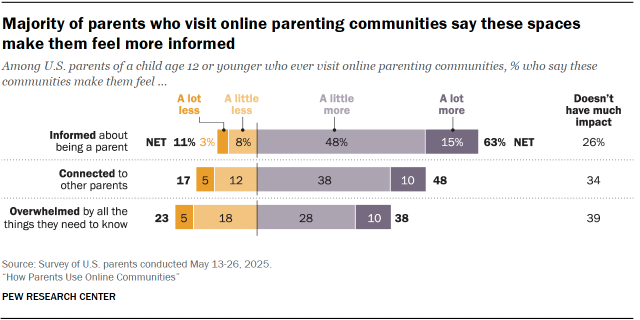
Among those who ever visit online parenting communities (even if only rarely), 63% say these spaces make them feel more informed about being a parent. And about half (48%) say online communities make them feel more connected to other parents.
But these experiences are not universally positive: 38% say parenting communities make them feel more overwhelmed because of all the information they need to know. And sizable shares say these communities make them feel less informed and less connected to other parents.
How many parents post or comment on these sites?
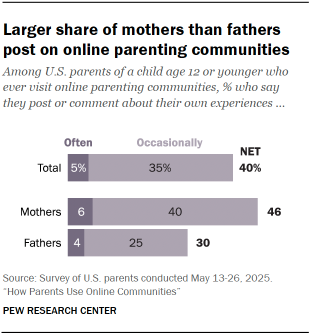
Among parents who ever visit online parenting communities, 40% say they have posted or commented about their own experiences as a parent. But only 5% say they do this often.
Mothers are more likely to engage in the discussion than fathers are. Some 46% of mothers who visit online parenting communities say they ever post or comment, compared with 30% of fathers.