
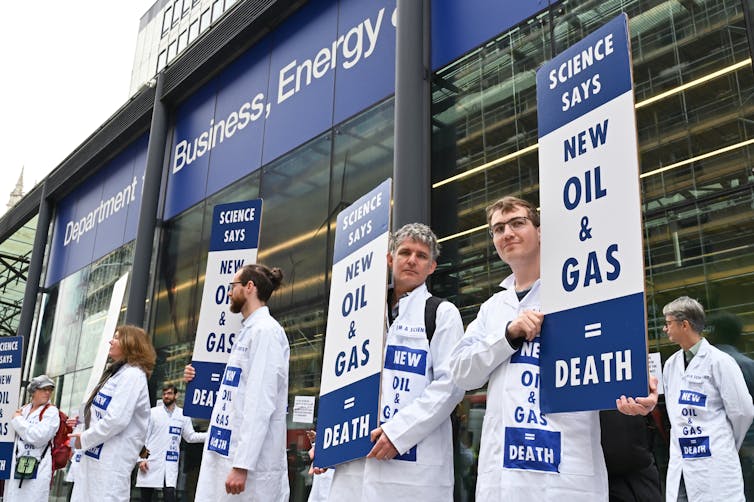
From marches and demonstrations to civil disobedience, scientists are increasingly turning to climate protest. As a social psychologist, I’ve been investigating why researchers – who are trained to value scientific norms of objectivity and restraint – choose to engage in such public and sometimes disruptive action.
My study, just published in the journal PLOS Climate addresses this question by exploring scientists’ own experiences and decision-making. I spent two years observing, participating with, and interviewing scientists engaged in climate activism to understand their motivations.
Science and activism are very different. Scientific training emphasises restraint, uncertainty, narrow expertise, and objectivity. Activism demands urgency, moral clarity, and visibility. This tension often fuels the critique that scientists who protest have abandoned scientific norms in favour of ideology. Yet, a significant number of scientists engage in advocacy and activism. This marks a culture change in how scientists communicate.
So, how do scientists advocate without betraying what it means to be a scientist?
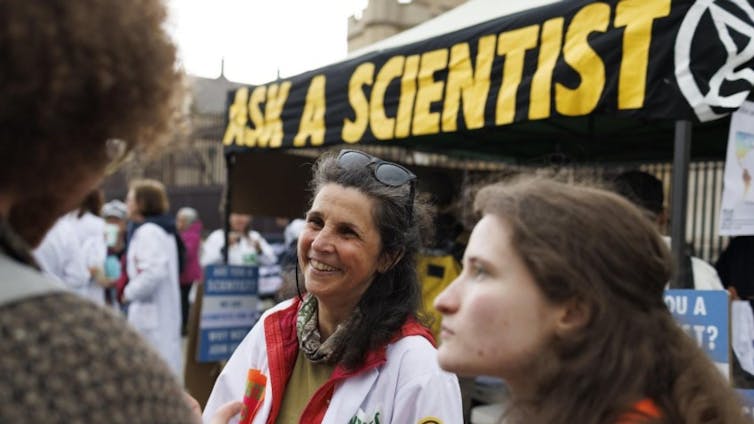
Most activism does not begin with actions that risk arrest such as blocking a road. Scientists typically become involved through roles aligned closely with their professional identity: public communication, giving talks, producing evidence summaries for social movements or acting as visible “scientist” figures within protest spaces. This reflects wider research showing that continuing to “feel like being a scientist” rather than stepping outside that role altogether, is critical for scientists’ engagement in activism.
Andrea Domeniconi, CC BY-NC-ND
The white lab coat is one tool scientists use to manage this tension. In protest spaces, it serves as visible signal of expertise, collective identity and legitimacy. Lab-coated scientists can challenge expectations of what an activist looks like, while also helping participants feel united and reassured that they are still acting as scientists. This helps reconcile identities that might otherwise appear in conflict.
However, for some social scientists who do not wear lab coats in their everyday research, this approach risks reinforcing narrow ideas about what counts as “real science”, both in public perception and within activist spaces, discouraging some from participating.
Acting alongside other scientists helps normalise and legitimise activism, reduce anxiety and build confidence. Being part of a collective also mitigates concerns about reputation damage. Participants nevertheless described activism as emotionally demanding. Continued involvement therefore depended on feeling supported by others.
Escalating actions
Some scientists choose to take part in civil disobedience, a form of peaceful protest that involves deliberately breaking the law to draw attention to an issue, such as sitting in roads or attaching themselves to buildings.
Many scientists told me this move was driven by frustration with the limits of conventional science communication. Many had spent years publishing research, advising policymakers and engaging with the media, yet saw little meaningful political response. For some, civil disobedience felt like a last resort. They framed it not as abandoning science, but as acting on it, when producing and communicating evidence no longer felt sufficient.
As one scientist, arrested during a protest at the London headquarters of the Department for Business, Energy and Industrial Strategy, said: “As scientists, we have tried to warn the world as reasonably and as rationally as possible, […] But what is the point of doing it if it just gets ignored?”
Crispin Hughes., CC BY-NC-ND
The challenges of advocating as a scientist
Once scientists appear in activist spaces, their identity is not always taken at face value. Wearing a lab coat or invoking scientific credentials can open conversations and signal trust. But it may also invite scepticism, heightened scrutiny, or unrealistic expectations that one person can speak for all of science. Participants described being questioned by members of the public, journalists and sometimes other scientists about whether they were “real scientists”, whether their research field counted, or whether they were qualified to speak at all.
Many scientists therefore found themselves balancing the need to speak with authority while remaining honest about the limits of their expertise. Research on scientist advocacy shows mixed effects on public trust, sometimes positive, sometimes negative, and often context-dependent.
Scientists in my study were acutely aware of this. They sought to manage how their activism was perceived by clarifying their expertise, acting alongside other scientists, and choosing forms of participation consistent with their professional values.
Looking at the wider picture, as political inaction, hostility towards climate activism, politicisation of science and misinformation grow, scientists face growing pressure not only to produce knowledge, but to decide how to visibly stand for it. The rise of scientist activism reflects this shifting terrain, and the difficult choices it brings.

Don’t have time to read about climate change as much as you’d like?
Get a weekly roundup in your inbox instead. Every Wednesday, The Conversation’s environment editor writes Imagine, a short email that goes a little deeper into just one climate issue. Join the 47,000+ readers who’ve subscribed so far.