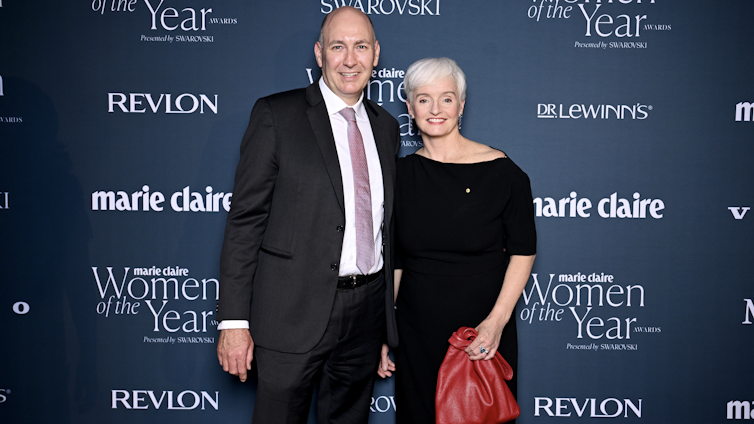
Emma Johnston, the Vice-Chancellor of the University of Melbourne who has died aged 52, was a marine ecologist, a visionary leader in science and research, a passionate champion of the environment, a brilliant and engaging communicator, and a caring mentor. Emma was also our friend.
Born in 1973 and raised in Melbourne, Emma’s star rose swiftly. Her success was driven by a deep love of science, problem-solving and teamwork. Dux of University High School in Melbourne (where there is now a house named after her), she ran the student newspaper and launched an environment group and recycling program.
After completing a PhD in marine ecology at the University of Melbourne, Emma became an associate lecturer at UNSW in 2001, where she built a thriving research group studying the impacts of pollution and climate change on marine and coastal ecosystems. In 2005 she established the Sydney Harbour Research Program, to understand and remediate that city’s great natural asset.
These themes of complexity, interdependence and ecosystem resilience would become guiding metaphors for her subsequent career as a research leader and a fierce advocate for science.
Emma believed research should be about teamwork rather than personal accolades. She supervised a remarkable 33 PhD students, as well as honours students and postdoctoral researchers, and she mentored countless colleagues throughout her career. Busy but never hurried, Emma was generous with her time and attention, and she loved meeting bright and curious people.
As a newly promoted professor, she was chosen to attend the 64th Lindau meeting of Nobel Laureates where she delivered the after-dinner speech.
Her research and science communication earned awards including the NSW Premier’s Award for Biological Sciences, the Australian Academy of Science’s inaugural Nancy Millis Medal for Women in Science and the Eureka Prize for Promoting Understanding of Science Research.
In 2018, she was made an Officer of the Order of Australia for her services to higher education and scientific research. She became a fellow of the Australian Academy of Technological Sciences and Engineering in 2019 and of the Australian Academy of Science in 2022.
AAP Image/Bianca De Marchi
Emma’s leadership has taken many forms. As president of the student union while at university, she delighted in political jousting and loud change-making. Each time she was underestimated in a new role, she was fond of reminding friends that her term as student union president had prepared her for even the cagiest reception.
As a presenter on TV show Coast Australia, her natural style and genuine delight at the wonders of the wild ocean resonated with audiences worldwide.
In 2017, Emma became president of Science & Technology Australia. While there, she helped establish the acclaimed Superstars of STEM program, which works to raise the profile of women and non-binary scientists, and became the organisation’s first president to address the National Press Club, where she proclaimed science’s potential to provide solutions for humanity’s problems.
At around the same time, she was appointed Dean of Science at UNSW, albeit after some initial reluctance about how the job would impinge on her time with her two young children. When her prospective employer offered her more money for childcare, she replied that she actually wanted to see her children, and that a better solution would be simply to not expect her to go to functions most nights of the week.
In February 2025, after a stint as Deputy Vice-Chancellor (Research) at the University of Sydney, Emma returned to her alma mater as Vice-Chancellor of the University of Melbourne. This appointment positioned her better than ever to work towards her dream of a resilient, informed and motivated citizenry that can weather the storms of climate upheaval and build a strong future for humanity and the planet.
As a member of the board of CSIRO and a governor of the Ian Potter Foundation, Emma’s leadership and impact on Australian research was broad.
She had a formidable clarity of purpose, and an abiding hope for humanity. Her resilience strategy for the University of Melbourne, finalised just weeks before her death on December 26 2025, was the first step in her ten-year plan to build an extraordinary, empowered and resilient Australia.
As director of the board of the Great Barrier Reef Marine Park Authority, Emma led the 2021 State of the Environment report for the Australian government. In it, she emphasised that the ocean could only absorb so much heat before it would reach catastrophic collapse. Emma wanted nothing less than to save the world, but – like the ocean – in the end she could only do so much.
Emma’s final months were marked by a fierce doubling-down on her mission – she understood she was running out of time. Only 52 years old when she died from complications associated with cancer, she still wasn’t done with parenting, with saving the oceans and the planet, with nurturing and uplifting the next generation, or with remaking the Australian research and higher education landscape.
In a recent voice memo to one of us (Kylie), she said:
What has driven me in my life is a deep love of the science, a love of working with people and helping them to flourish and achieve, and a desire to work with others to protect this world I was immersed in as a scientist. And in that, I feel I have gone well beyond what I ever set out to achieve.
Survived by her husband Sam and their two children, Emma Johnston truly was a leader for our age, a star whose light burned out too soon.