
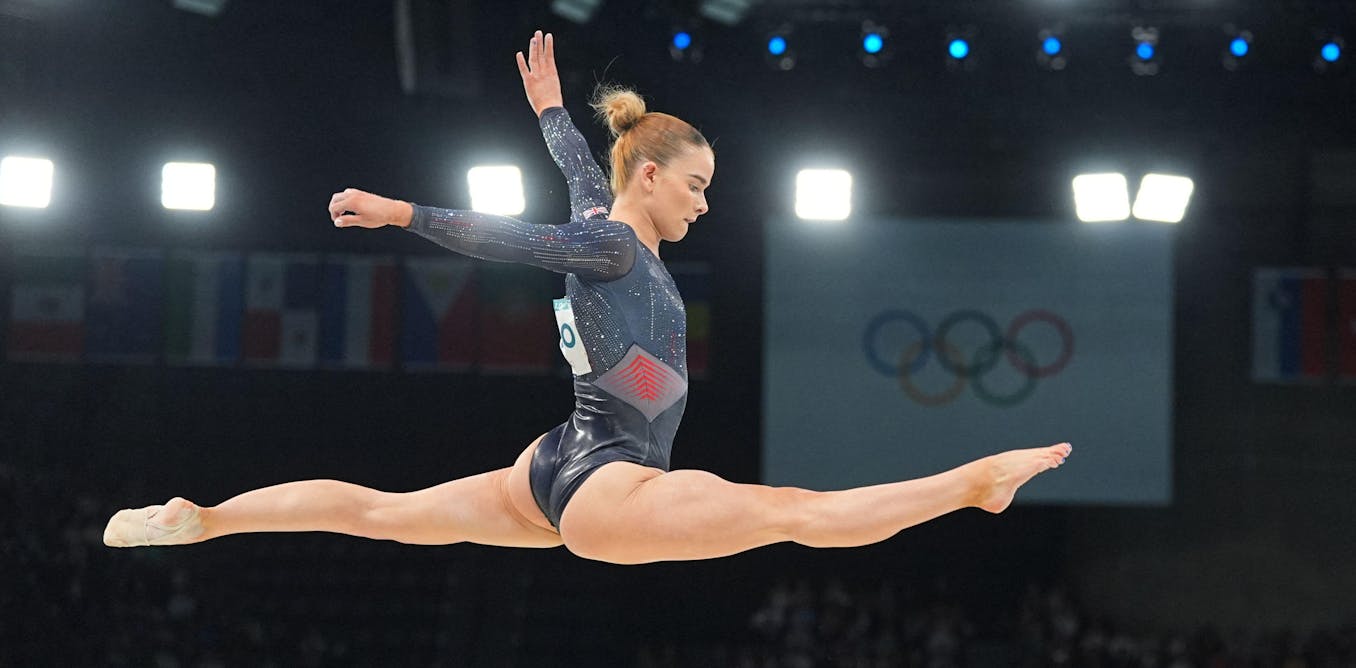
When Olympian Alice Kinsella talks about returning to elite competition after giving birth, she isn’t simply planning a comeback; she’s pushing into territory that gymnastics has rarely explored.
Increasingly, athletes are returning to training and competition after childbirth, often sooner, stronger and with greater public visibility. This challenges the long-held expectation that women must retire to have a family. Although this shift is now becoming well established in several sports, such as long-distance running and team sports, others remain constrained by narrow ideas about when peak performance should occur.
Women’s artistic gymnastics sits at the sharp end of this debate. For much of the modern Olympic era, the sport became synonymous with “little pixies”:
exceptionally young champions, lightweight bodies and careers that peaked
early then ended quickly.
Over the past 20 years, the age at which gymnasts reach peak performance has slowly risen from teenage years to early 20s, bringing elite success into overlap with the years many women plan to have children. When these timelines overlap, athletes may feel pressured to choose between motherhood and peak performance. This is because research in gymnastics has not yet properly studied what happens to the body during and after pregnancy. That imbalance highlights a wider gender gap that has shaped sports science.
As gymnasts themselves begin to stay in the sport longer, return after maternity leave and challenge these assumptions, science has a responsibility to respond.
We still don’t know what it takes to return to elite performance in sports like gymnastics, where power, precision and impact tolerance are non-negotiable.
Unlike endurance sports, where training load can often be increased gradually, gymnastics requires athletes to perform highly technical skills under significant mechanical stress and to face substantial psychological demands related to fear regulation and confidence.
In elite gymnastics, the margin for error is tiny. Performance depends on strength, fine coordination and the ability to control the body under extreme physical and psychological demands. Even small changes in how a gymnast moves or lands can dramatically affect performance and increase the risk of injury.
Gymnasts generate a spring-like push in a fraction of a second through their feet and hands, striking the vault with forces of up to three times their body weight. Then, they land with 15-20 times body weight through their legs and spine, all while balancing on a beam no wider than a smartphone.
They make danger look graceful. In fact, even though gymnastics has no physical contact, almost all elite gymnasts (90%) are injured each season, putting gymnastics in the same risk range as football.
Mariano Garcia/Alamy
When mothers fly
Pregnancy-related changes in body mass distribution, joint loading and neuromuscular control influence how gymnasts land, generate force and regulate movement. For example, changes in core and pelvic stability can alter how forces are absorbed during landing, while small shifts in balance or timing can affect take-off accuracy and rotation in flight. These changes can affect injury risk, confidence and technical consistency.
In 2018, the International Olympic Committee published for the first time guidance on returning to exercise after pregnancy, but it offers little insight into how performance-critical capacities are rebuilt.
In artistic gymnastics, examples of return post-pregnancy have historically been rare and often overlooked. One of the earliest and most striking cases is Uzbekistani artistic gymnast Oksana Chusovitina. She gave birth to her son in 1999 at age 24 and returned less than a year later to compete at the Sydney 2000 Olympic Games. In the years following childbirth, she won World Championship gold on vault in 2003 and went on to compete internationally for more than two decades. Chusovitina showed how narrow gymnastics’ ideas about age were, but for years she was treated as a one-off.
Real change began in the mid-to-late 2010s. Gymnasts stayed in competitive career longer and average ages rose. Changes to the International Gymnastics Federation, which governs competitions in all disciplines of gymnastics, code of points rewarded experience. Between 2003 and 2016, elite female gymnasts became an average 3.3 years older, shifting from about 17 years old to 20–21. Gymnasts like Simone Biles (US, 28), Rebeca Andrade (Brazil, 26), Becky Downie (UK, 34) and Ellie Black (Canada, 30), to name a few, were winning medals in their late 20s and early 30s.
British Olympian Alice Kinsella represents something new. Her planned return after childbirth isn’t just about coming back. It’s about how she’s doing it, with structured scientific support, tracked as part of an academic case study. Kinsella’s approach turns a risky return into something that can be understood, supported and repeated by other gymnasts.
Not all attempts have been successful. Aliya Mustafina, a Russian double Olympic champion, gave birth to her daughter in 2017 at the age of 24 and returned to competition within 16 months, aiming to re-establish herself at the highest level during the next Olympic cycle. Despite her experience and determination, persistent injuries limited her ability to compete, and she ultimately retired in 2021. There is no evidence these injuries were caused by pregnancy, but her experience shows how fragile post-pregnancy pathways in gymnastics still are.
More recently, gymnast Jade Barbosa provides further evidence of this shift. A three-time Olympian and a member of Brazil’s historic bronze-medal winning team at the Paris 2024 Olympic Games, Barbosa welcomed her first child in late 2025. During pregnancy, she publicly shared aspects of her training and has stated her intention to return to competition.
These stories show that attitudes are changing. More gymnasts are pushing back against the idea that they have to choose between performing at their best and becoming a mother.
Why this matters
For years, performance research has focused mostly on men, partly because women’s bodies change more over time due to hormonal fluctuations, making results harder to compare. Pregnancy and recovery after birth add further challenges, alongside ethical concerns and limited funding. That is why case studies like the one planned around Kinsella are vital.
Elite sport influences how people think about women’s bodies. If returning to sport after having a baby is always described as exceptional, it can make staying active after childbirth seem unrealistic for most women.
If post-pregnancy return becomes normal rather than exceptional, the timeline of female performance changes permanently, and so do the expectations placed on women in sport.