
This article presents key results from the Global Value Chains survey on international sourcing. International sourcing, often referred to as outsourcing, involves the partial or full relocation of business activities by enterprises to affiliated or non-affiliated partners located abroad. The results provide insight into how European enterprises organise their activities and how this affects jobs and production within the EU. The data cover the three-year reference period 2021–2023, were collected in 2024, and are cumulative over the full reference period and comparable across countries.
Between 2021 and 2023, 72.8% of EU enterprises that engaged in international sourcing moved their business functions to other EU countries. Outside the EU, the largest sourcing destinations were India (18.6%) and the United Kingdom (17.1%).
The main motivational factors for international sourcing included reduction of labour costs (for 34.1% of sourcing enterprises), reduction of other costs (27.8%), or focusing on their core business (20.3%).
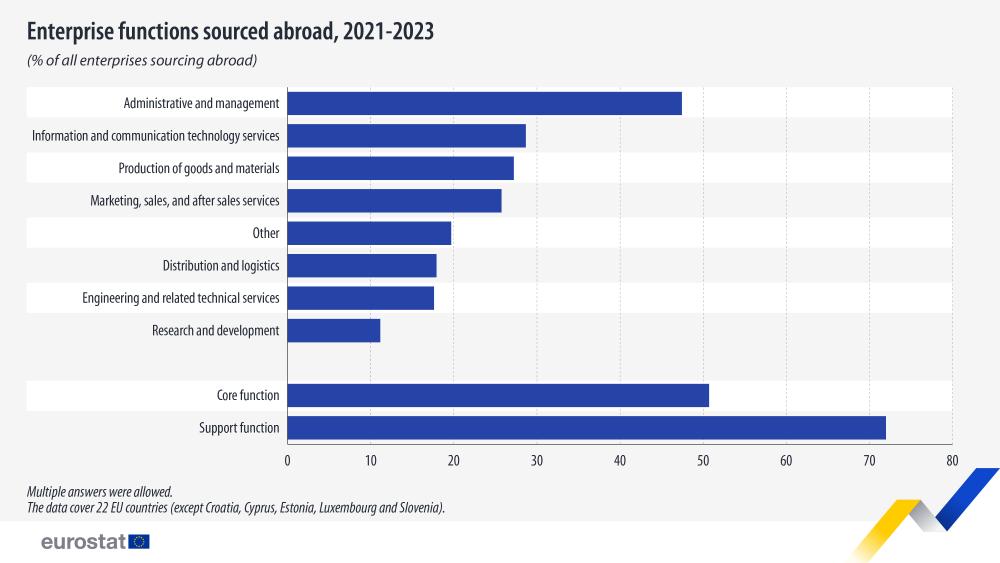
Enterprises that source abroad most frequently move administrative and management functions (47.4%) and information and communication technology and services (28.7%), reflecting the increasing tradability of service functions.
Source dataset: gvc_sobfbp
These figures present the first official results of the Global Value Chains (GVC) survey carried out across 22 EU countries and Norway. This article presents a handful of findings from a more detailed Statistics Explained article on international sourcing, business functions and global value chains.
Job impact of international sourcing
During 2021-2023, enterprises in 22 EU countries reported that due to international sourcing 52 853 jobs were created (0.08% of all jobs in enterprises with 50+ employees) and 152 023 jobs were lost (0.22%). While individual job impacts remain small (99 170 net jobs lost, or 0.14% of total jobs), their cumulative effect over time should not be overlooked.
Overall, the majority of lost jobs were in the production of goods and materials (-53 577 jobs; -0.30% of all production jobs) and administrative and management work (-33 818 jobs; -0.33%). However, these business functions also created new jobs in the EU due to international sourcing, with gains of 12 762 jobs (+0.07%) in administrative and management, and 12 493 jobs in production (+0.13%).
In relative terms, information and communication technology services lost the highest share of jobs to international sourcing (-0.46%; -15 308 jobs), followed by research and development jobs (-0.37%; -4 858 jobs). However, these sectors also experienced the largest relative gains, as 0.24% of research and development jobs were created by international sourcing (+3 135 jobs) and 0.21% of information and communication technology jobs (+6 869 jobs).

Source dataset: gvc_sojobbf