57% express some sympathy for both Israelis and Palestinians
Pew Research Center conducted this survey to explore views about the Israel-Hamas war. We surveyed a total of 12,693 U.S. adults from Feb. 13 to 25, 2024. Most of the respondents (10,642) are members of Pew Research Center’s American Trends Panel, an online survey panel recruited through national random sampling of residential addresses, which gives nearly all U.S. adults a chance of selection.
The remaining 2,051 respondents are members of three other survey panels – Ipsos’ KnowledgePanel, SSRS’s Opinion Panel, and NORC at the University of Chicago’s AmeriSpeak Panel – who were interviewed because they identify as Jewish or Muslim.
We “oversampled” (i.e., interviewed a disproportionately large number of) Jews and Muslims to provide more reliable estimates of their views on the topics covered in this survey. But these groups are not overrepresented in the national estimates reported here, because we adjusted for the oversampling in the weighting of the data. The survey is weighted to be representative of the U.S. adult population by gender, race, ethnicity, partisan affiliation, education, religious affiliation and other categories. In total, 1,941 Jewish and 414 Muslim respondents participated in this survey.
While the sample design was identical for Jews and Muslims, the resulting sample sizes are different. There are two main reasons for this. The Jewish population in the United States is roughly double the size of the Muslim population. Consequently, national survey panels have roughly twice as many or more Jewish panelists as Muslim ones. In addition, decades of research on survey nonresponse has shown that some groups in the U.S. are more likely to participate in surveys than others. Generally speaking, Jewish adults are more likely to participate in surveys than Muslim adults.
The survey also included questions about where people were born and whether people identify as Arab or of Arab origin. Because of insufficient sample size, we are unable to analyze Arab Americans or Americans of Israeli or Palestinian descent separately.
In this survey, Jews and Muslims are defined as U.S. adults who answer a question about their current religion by saying they are Jewish or Muslim, respectively. Unlike our 2020 report on Jews in America, this report does not separately analyze the views of “Jews of no religion” (i.e., people who identify as Jewish culturally, ethnically or by family background but not by religion).
For more information on how we conducted this survey, refer to the ATP’s Methodology and the Methodology for this report. Read the questions used in this report, along with responses.
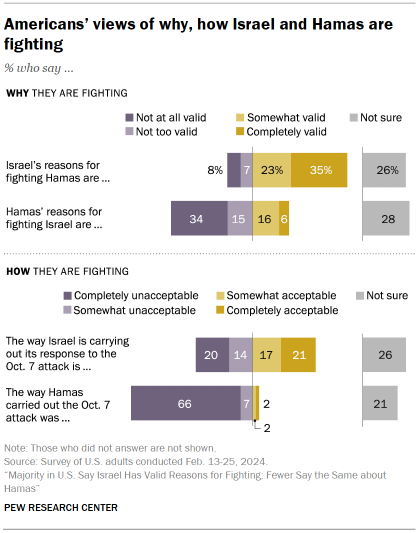
Months into the Israel-Hamas war, roughly six-in-ten Americans (58%) say Israel’s reasons for fighting Hamas are valid. But how Israel is carrying out its response to Hamas’ Oct. 7 attack receives a more mixed evaluation. About four-in-ten U.S. adults (38%) say Israel’s conduct of the war has been acceptable, and 34% say it has been unacceptable. The remaining 26% are unsure.
Only around one-in-five Americans (22%) think the way the Israeli government is carrying out the war against Hamas will make the Israeli people more secure than they were before the war. The rest think the war will make Israelis less secure (27%), not have much effect (15%) or say they are unsure (35%).
When asked about Hamas’ reasons for fighting Israel, far fewer Americans (22%) describe them as valid. And just 5% of U.S. adults say the way Hamas carried out its Oct. 7 attack on Israel was acceptable, while 66% describe it as completely unacceptable.
Also, few Americans (10%) think Hamas’ actions will make the creation of an independent Palestinian state more likely than it was before the war. Around a third of the U.S. public thinks it will make an independent state less likely (32%) while 15% say it will not have much effect and 41% are unsure.
How these questions were worded
Some questions in this survey ask Americans for opinions on how Israel and Hamas have been fighting. Other questions ask for opinions on why each side has been fighting.
After pretesting the questions, here is the exact wording we settled on:
How they are fighting
- Do you think the way Hamas carried out its attack on Israel on Oct. 7 was … Completely acceptable, Somewhat acceptable, Somewhat unacceptable, Completely unacceptable, Not sure
- Do you think the way Israel is carrying out its response to Hamas’ Oct. 7 attack is … Completely acceptable, Somewhat acceptable, Somewhat unacceptable, Completely unacceptable, Not sure
Why they are fighting
- Regardless of how acceptable you find the way Hamas carried out the Oct. 7 attack, do you think Hamas’ reasons for fighting Israel are … Completely valid, Somewhat valid, Not too valid, Not at all valid, Not sure
- Regardless of how acceptable you find the way Israel is carrying out the war in Gaza, do you think Israel’s reasons for fighting Hamas are … Completely valid, Somewhat valid, Not too valid, Not at all valid, Not sure
This issue is challenging for many people – both emotionally and in terms of understanding the specifics of the war. Many Americans are also disengaged: Relatively few (22%) say they are closely following news about the war, and half can correctly report that more Palestinians than Israelis have died since the war’s start. On many questions about the war, sizable numbers express no opinion.
These and other results come from a new Pew Research Center survey, conducted Feb. 13-25, among 12,693 adults. Unlike most polling in the United States since the war began, this survey includes enough Jewish and Muslim respondents to allow their views to be analyzed separately.
When it comes to how Jews and Muslims feel about why and how the two sides are fighting, we find:
Views on why they are fighting
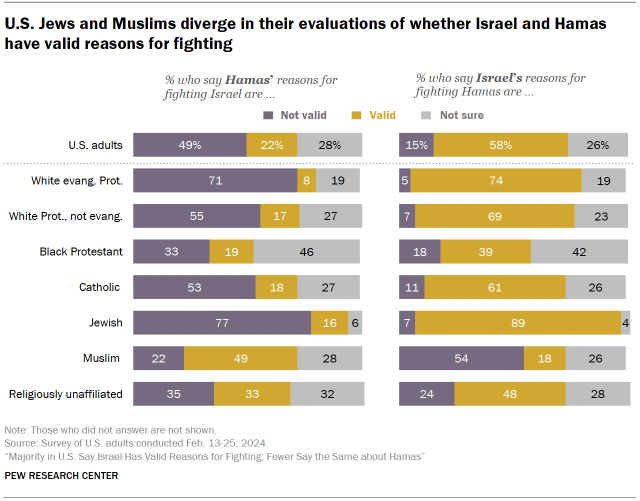
- Regardless of whether they approve of how Israel is fighting the war, most U.S. Jews (89%) see Israel’s reasons for going to war against Hamas as valid.
- Only 18% of U.S. Muslims see Israel’s reasons as valid.
- Around half of Muslims (49%) say Hamas’ reasons for fighting Israel are valid, regardless of how they feel about the acceptability of the Oct. 7 attack.
- Among Jews, 16% see Hamas’ reasons as valid – about the same share as in most other U.S. religious groups large enough to be analyzed separately.
Views on how they are fighting
- 62% of U.S. Jews say the way Israel is carrying out its war in Gaza is acceptable; only 5% of American Muslims agree.
- While few people in any religious group describe Hamas’ Oct. 7 attack as acceptable, the share of Muslims (21%) who express this view is higher than the share of Americans in other religious groups who say the same (roughly 5% or fewer, including 3% among Jewish Americans). Among U.S. Muslims, 10% say the way Hamas carried out the attack was completely acceptable; 11% say it was somewhat acceptable.
Americans’ emotional reactions to the war
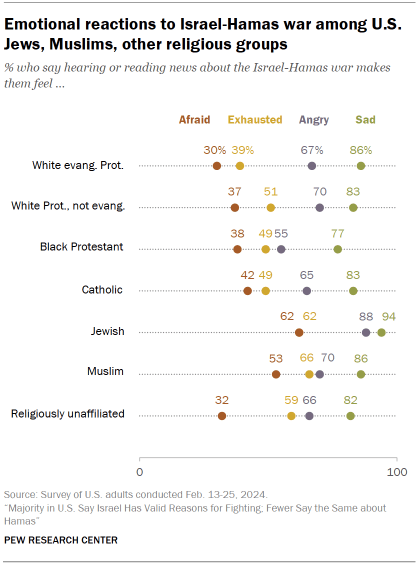
In the U.S., 62% of Jews and 53% of Muslims report that hearing or reading news about the Israel-Hamas war makes them afraid. In other religious and nonreligious groups, the share expressing fear is lower. Jews are also more likely than other U.S. religious groups to say news about the conflict makes them feel angry.
American Jews and Muslims are also paying more attention to the war than other groups analyzed, with 61% of Jews and 41% of Muslims saying they’re following it extremely or very closely.
Jewish and Muslim respondents in this survey
Pew Research Center surveys conducted on our American Trends Panel (ATP) always include Jews and Muslims. But these surveys do not always have enough Jewish or Muslim respondents to report their answers separately. This is because they make up relatively small shares of the U.S. adult population: Roughly 2% of Americans say their religion is Judaism, and 1% say their religion is Islam.
To provide more reliable estimates of Jewish and Muslim views on the topics covered in this survey, we included Jewish and Muslim respondents from three other national panels run by large research organizations (Ipsos, NORC and SSRS). All these panels are probability based, meaning they use random sampling methods to recruit respondents. They are not “opt-in” polls. In total, 1,941 Jewish and 414 Muslim respondents participated in this survey.
In this report, Jews and Muslims are defined as U.S. adults who answer a question about their current religion by saying they are Jewish or Muslim, respectively. Unlike our 2020 report on Jews in America, this report does not analyze the views of “Jews of no religion” (i.e., people who identify as Jewish culturally, ethnically or by family background but not by religion).
While the sample design was identical for Jews and Muslims, the resulting sample sizes are different. There are two main reasons for this. The Jewish population in the U.S. is roughly double the size of the Muslim population. Consequently, national survey panels have roughly twice as many or more Jewish panelists as Muslim ones. In addition, decades of research on survey nonresponse has shown that some groups in the U.S. are more likely to participate in surveys than others. Generally speaking, Jewish adults are more likely to participate in surveys than Muslim adults.
Views of how, why the war is being fought, by age
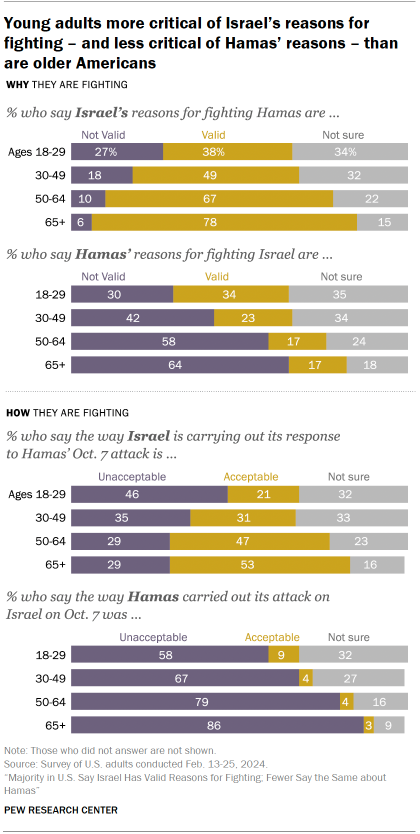
There are also stark differences across age groups in views of the war. For example:
- Roughly equal shares of adults under 30 say Hamas’ reasons for fighting Israel are valid (34%) and not valid (30%); 35% are unsure. By comparison, most of those ages 65 and older say Hamas’ reasons are not valid (64%).
- Younger adults are significantly more critical of how Israel is fighting in the war than are older people: 21% of Americans ages 18 to 29 say the way Israel is carrying out its response to Hamas’ Oct. 7 attack is acceptable; 46% describe it as unacceptable.
Age differences also are evident in many other issues related to the war, which are explored in other chapters of this report. Some key findings include:
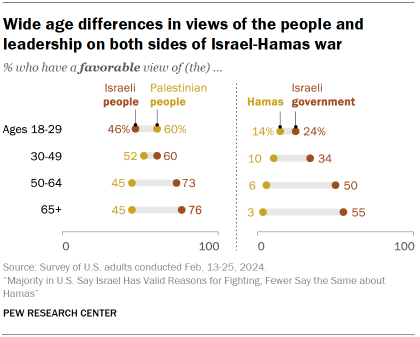
- More younger Americans express favorable views of the Palestinian people (60%) than of the Israeli people (46%). Relatively few have positive views of either the Israeli government (24%) or Hamas (14%). And, among Democrats and Democratic-leaning independents under 30, the Israeli government (16%) and Hamas (18%) are held in equally low esteem. (Explore more in Chapter 1.)
- Younger adults are much less supportive of the U.S. providing military aid to Israel than are older people, but they’re also somewhat less in favor of the U.S. providing humanitarian aid to Gaza or playing a major diplomatic role in resolving the conflict. (Explore more in Chapter 2.)
- Younger Americans are more likely than older adults to say the way the Israeli government is carrying out the war against Hamas will make the Israeli people less secure than they were before the war – though large shares across all age groups are unsure. (Explore more in Chapter 3.)
- As with other international news events, the Israel-Hamas war appears to be drawing less attention from younger adults than from older people. Just 14% of those under 50 say they are following the war extremely or very closely, roughly half the share among those over 50 (30%). Consistent with their lower levels of attention, younger Americans are also less likely to know key facts about the ongoing war, based on their responses to three knowledge questions included on the survey. (Explore more in Chapter 4.)
Related: How Americans view the conflicts between Russia and Ukraine, Israel and Hamas, and China and Taiwan
Where Americans’ sympathies lie
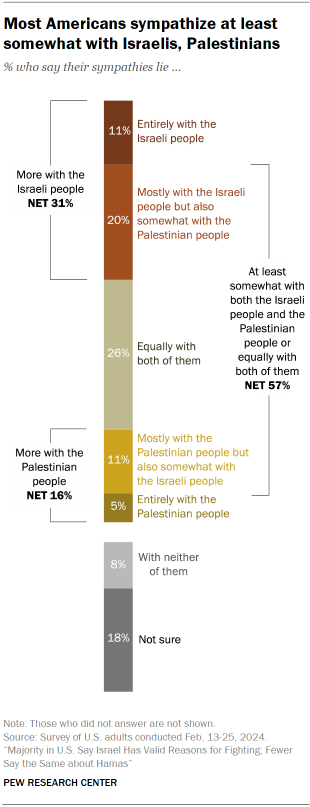
Few Americans say they sympathize entirely with either the Israeli people (11%) or the Palestinian people (5%). Rather, 57% sympathize at least to some extent with both Israelis and Palestinians, including 26% who say their sympathies lie equally with both groups.
A much smaller share of U.S. adults (8%) say they do not sympathize with either group, while 18% are unsure.
To the degree that Americans sympathize more with one group than the other, 31% say their sympathies lie either entirely or mostly with the Israeli people. This is about twice as many as say their sympathies lie either entirely or mostly with the Palestinian people (16%).
By a margin of more than 2-1, adults under 30 sympathize relatively more with Palestinians than with Israelis (33% vs. 14%), while the balance of opinion is reversed among older age groups.
Much of this is related to young Democrats and Democratic leaners, 47% of whom sympathize either mostly or entirely with Palestinians. Young Republicans and GOP leaners, on the other hand, are slightly more likely to sympathize either entirely or mostly with Israel (28%), or with both sides equally (24%), than entirely or mostly with Palestinians (12%). Substantial shares of both young Democrats (19%) and young Republicans (24%) say they are unsure where their sympathies lie.
Views of the people and leadership in the war
Americans tend to express much more favorable views of the people on both sides of the Israel-Hamas war than of the leadership on either side (the Israeli government, the Palestinian Authority and Hamas).
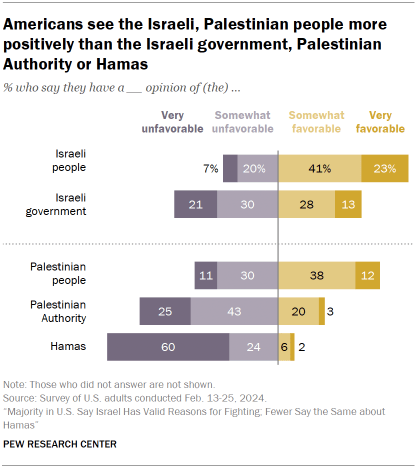
For example, 64% of U.S. adults say they have a favorable view of the Israeli people, compared with 41% who express a favorable view of the Israeli government.
The same is true of views of the Palestinian people (50% favorable) compared with either the Palestinian Authority, which controls the West Bank (23% favorable), and especially relative to Hamas, which has controlled Gaza in recent years (8% favorable). Indeed, six-in-ten Americans express very unfavorable views of Hamas.
Views of the Israeli government have become more negative since 2022. Today, 41% of U.S. adults express a favorable view of the Israeli government, down from 47%. The share who express very unfavorable views of the government also has nearly doubled over this time period, from 12% to 21%. (We do not have data on how views of the Palestinian Authority or Hamas have changed over time.)
Among adults under 30, the share expressing a favorable view of the Israeli people has fallen 17 percentage points since 2019, while their views of the Palestinian people have not shifted over this timespan. Older people’s views of both Israelis and Palestinians have remained largely unchanged.
Why this report uses the term ‘Israel-Hamas war’
How to describe the current war, both for the respondents taking the survey and when writing up the results, is not a choice we made lightly.
First, we consulted The Associated Press Stylebook, a resource we often follow. According to the AP Stylebook, “The Associated Press is calling the present conflict between Israel and the militant Palestinian group Hamas a war … Do not use terms such as Israel-Palestinian war or Gaza war.”
Second, we consulted with outside experts who recommended we avoid terminology suggesting that Israeli forces are fighting only in Gaza when, in reality, they are also active on other fronts, including against Hezbollah in Lebanon.
Third, we conducted pretests with 17 respondents and asked them, “Do you have thoughts on using the phrase ‘Israel-Gaza war’ instead of ‘Israel-Hamas war’?” While around half did not have an opinion, among those who did, several felt “Israel-Hamas war” was more accurate. For example, one respondent said, “It should be the Israel-Hamas war because it’s not a Gaza thing, it’s Hamas versus Israel. They started it.” Another noted, “I don’t agree with saying Israel-Gaza war. It’s Israel-Hamas. That’s who they are going after.” Still, two respondents said the opposite. One said, “It’s more Israel-Gaza than Israel-Hamas [because] it’s not really Jews against Palestinians, so we should focus on a country and that region.” Another said, “Gaza sounds bigger than the Hamas part does.” All 17 respondents said the questions we asked seemed neutral, rather than appearing to favor a particular side in the ongoing war.
After completing the survey, the 12,693 respondents who took it were also asked whether they found the survey to be politically neutral, and 92% did, including large majorities of Muslims and Jews.
What role do Americans think the U.S. should play?
Americans are divided about how – and whether – the U.S. should be involved in the Israel-Hamas war.
- More than twice as many Americans favor providing humanitarian aid to Gaza as oppose it (50% vs. 19%). About three-in-ten say they either have no clear preference or are not sure. (This question was asked before the United States began airdropping food and other supplies in Gaza and announced plans to build a temporary port to allow aid to arrive by sea.)
- Providing military support to Israel is much more divisive: 36% of Americans favor providing U.S. military aid to help Israel in its war against Hamas, while 34% oppose it. The remainder say they neither favor nor oppose military aid (14%) or are not sure (15%).
- Only 20% of Americans want the U.S. to play a major diplomatic role in resolving the Israel-Hamas war. Another 35% want the U.S. to play a minor role, while 27% prefer that it play no role at all.
Democrats and Democratic-leaning independents differ sharply from Republicans and Republican-leaning independents in their attitudes toward U.S. involvement in the war.
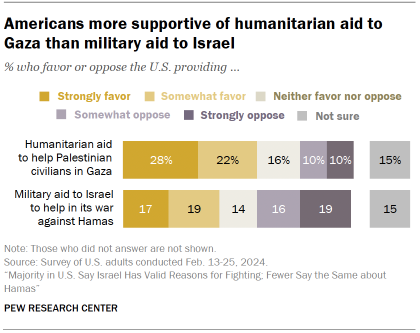
Democrats are much more supportive than Republicans of providing humanitarian aid in Gaza (66% vs. 35%) and of the U.S. playing a major diplomatic role in resolving the war (25% vs. 16%).
Indeed, Republicans are twice as likely to say the U.S. should play no role (32%) as they are to say the U.S. should play a major role (16%) in solving the conflict; 37% support the U.S. playing a minor role. However, Republicans are twice as likely as Democrats to favor providing military aid to Israel to help in its war against Hamas (50% vs. 25%).
Do Americans think Biden is striking the right balance?
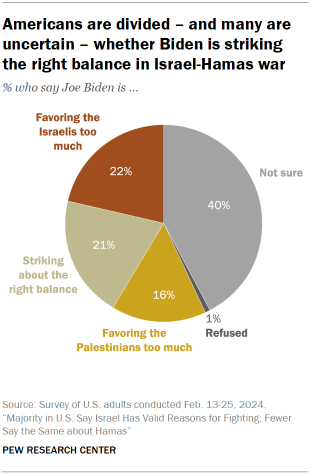
U.S. public opinion is deeply divided – and to a large extent uncertain – about whether President Joe Biden is striking the right balance in his approach to the war (21%), favoring the Israelis too much (22%) or favoring the Palestinians too much (16%). The largest single slice of the public –40% – is not sure how well Biden is handling the issue.
While these views are broadly similar to what we found in a December 2023 Pew Research Center survey, opinion among those under 30 has shifted. In the February survey, 36% of those ages 18 to 29 say Biden is favoring Israel too much, up from 27% just a few months ago. (Explore this further in Chapter 2.)
American Jews stand out for the relatively high share who say Biden is striking the right balance (45%). Only around a quarter or fewer in most other religious groups say the same, including just 6% of U.S. Muslims. Muslims are among the U.S. religious groups that are most inclined to say Biden favors the Israelis too much (60%). Among other religious and nonreligious groups, atheists (52%) and agnostics (43%) are especially likely to express this view.
What’s next? Americans’ views on a long-term resolution to the war
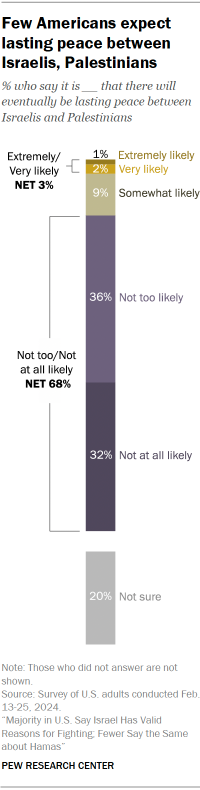
One of the few opinions a solid majority of Americans can agree on when it comes to the Israel-Hamas war is that lasting peace is unlikely. Only 3% say it is either extremely or very likely, while 9% say it’s somewhat likely. Fully 68% say a lasting peace between Israelis and Palestinians is either not too or not at all likely.
Opinion is somewhat more mixed when it comes to the best possible outcome of the conflict. A plurality (40%) says the best outcome would be a two-state solution – splitting the land into two countries, one with an Israeli government and one with a Palestinian government. But many Americans remain unsure of the best outcome (30%), and some prefer a model in which all the land is one country with an Israeli government (14%) or one country that is jointly governed by Israelis and Palestinians (13%). Few prefer the land to be one country with a Palestinian government (2%).
Jewish Americans (46%) and Muslim Americans (41%) also tend to think a two-state solution is the best possible outcome, but about one-in-five people in each group support a one-state option. Among Jews, 22% would prefer for all the land to be one country with an Israeli government. Among Muslims, 20% would like all the land to be under a Palestinian government.
Overall, Americans’ support for a two-state solution has increased modestly since 2022, from 35% to 40%. Much of the shift has come among Democrats and Democratic-leaning independents. Today, 48% of Democrats favor a two-state solution, up from 36% in 2022. Indeed, this shift has opened up a partisan gap in views of the two-state solution that was not present in 2022.
Among Republicans, the two-state solution is endorsed by 33%, while 26% think the best outcome would be for a single country, with an Israeli government, to control all the land. (Explore this further in Chapter 3.)