
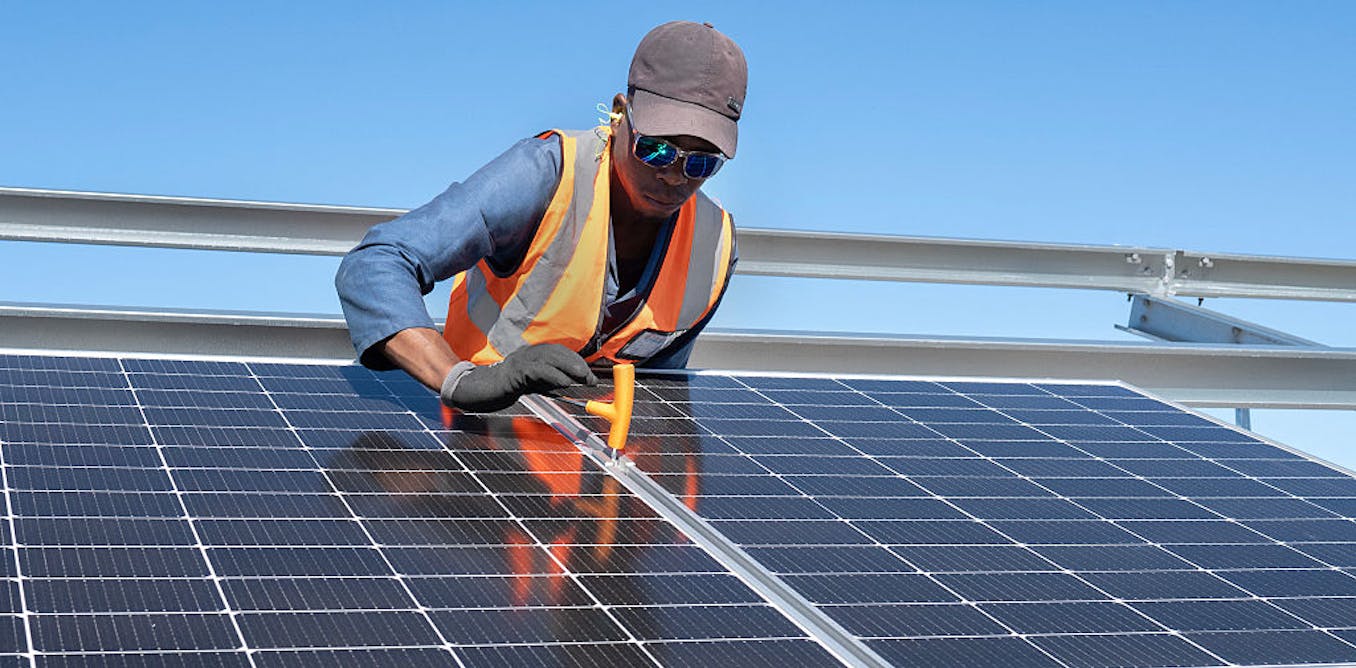
South Africa’s green transition is creating jobs. But not for everyone.
The country’s economy has historically been heavily reliant on coal. Around 70% of its energy is generated from coal. This makes it one of the world’s most carbon-intensive economies.
To reduce greenhouse gas emissions and modernise the energy system, the government is advancing a transition towards renewable energy, improved energy efficiency, and the development of low-carbon industries. This shift forms part of South Africa’s commitment to a just energy transition, supported by international partners through the Just Energy Transition Partnership.
The transition is unfolding in a context of persistently high unemployment. The official rate is 30%. Youth unemployment is particularly severe. In response, policymakers and international organisations have promoted green industrial development and investment in renewable energy as potential drivers of job creation and inclusive growth.
But the extent to which these opportunities will be equitably distributed remains an open question.
South Africa’s move towards a greener economy is often presented by policymakers, international development institutions and energy transition strategies as achieving two objectives: lower carbon emissions and more jobs.
But does the data support this claim?
We are economists working on labour markets, structural change and the just energy transition. In a recent research paper we set about answering the question. In the study we combined South Africa’s labour force survey data with occupational information that identifies environmentally related work activities – green occupations. This allowed us to track green employment trends over time and examine which sectors and workers benefit most from the transition.
Our research findings show that green employment is indeed growing. However, the benefits are uneven. Some sectors and groups of workers are gaining ground. Others risk being left behind.
South Africa’s commitment to a just energy transition implies that workers and communities affected by structural change should not bear disproportionate costs.
But justice is not only about protecting workers in declining sectors. It is also about ensuring that new opportunities are broadly accessible.
Where jobs are being created, and where they’re not
What counts as a “green job”?
One of the first challenges is defining what a green job is. According to the International Labour Organisation, green jobs are decent jobs that contribute to preserve or restore the environment. They can be in traditional sectors such as manufacturing and construction. Or they can be in new emerging green sectors such as renewable energy and energy efficiency.
In our research, we developed a method to classify green employment in South Africa. We combined South Africa’s occupational classification system, which groups jobs according to tasks and skills, with international data linking specific work activities to environmental sustainability.
These jobs include work directly connected to renewable energy, energy efficiency, environmental management, waste reduction and sustainable finance.
This approach allowed us to move beyond broad assumptions and measure where green employment is actually happening in the labour market.
Our findings showed that the share of green jobs has increased gradually over time from 12.4% in 2022 to 14.8% in 2024. That suggests the transition to a greener economy is underway. But it’s not happening evenly across the economy.
Green jobs are concentrated in a handful of sectors:
utilities, particularly electricity and water
mining, including environmental rehabilitation and renewable energy components
construction, especially green buildings and energy-efficient infrastructure
finance. Here jobs are being created through sustainability reporting and environmental, social and governance investment activities.
These patterns reflect where regulation, investment and policy signals have been strongest. Government-led initiatives act as major catalysts. Examples include:
renewable energy procurement
environmental compliance requirements – including stricter environmental governance – force firms to invest in greener technologies and compliance measures. This creates a direct demand for environmental, technical, and engineering roles.
sustainable finance initiatives. These are shaping labour demand.
Other sectors show far less green penetration.
The demographic profile of green employment also reveals important patterns.
Green jobs are more likely to be:
held by younger workers
located in the formal sector; informal workers are underrepresented
associated with moderate levels of education (including post-secondary or technical qualifications rather than highly specialised professional degrees)
dominated by men. Gender disparities are noticeable.
This suggests that green growth does not automatically translate into inclusive growth.
Without deliberate policy intervention, existing inequalities may simply be reproduced within new sectors.
What needs to be done
Our findings highlight four policy implications.
Firstly, skills policy is central.
Many green jobs require specific technical or regulatory competencies. These range from renewable energy engineering and environmental auditing to sustainable finance and compliance expertise.
If the education and training system does not respond quickly enough, skill shortages could limit job creation. At the same time, workers without access to training may be excluded.
Active labour market policies, vocational training reforms and targeted upskilling programmes are therefore critical.
Secondly, the transition needs sectoral depth.
Green employment is concentrated in a few industries. Expanding the transition into manufacturing, services and small-scale enterprises could broaden employment effects.
This requires coordinated industrial, energy and trade policy. Localisation strategies in renewable energy value chains, for example, could deepen job creation beyond installation and maintenance.
Thirdly, informal workers must not be ignored. South Africa’s informal economy employs millions of people. Yet green employment, as currently structured, is largely formal.
Waste pickers, small-scale recyclers and informal repair services already contribute to environmental sustainability. Integrating and supporting these workers through policy and municipal systems could strengthen both environmental and social outcomes.
Fourthly, measurement matters.
Green transitions are often discussed in aspirational terms. But policy making requires evidence.
Developing robust methods to identify and track green employment allows government and stakeholders to monitor progress, assess distributional impacts and adjust policy accordingly. Without data, the idea of a just transition remains rhetorical.
A green economy can support employment – with the right choices.
South Africa’s statistical system could also improve measurement of green employment. Statistics South Africa could incorporate questions in the labour force survey that capture environmentally related work tasks, skills and training. It could also develop a national classification of green occupations and industries aligned with international standards. Better data would allow policymakers to monitor the employment effects of the transition more accurately.
Our findings do not undermine the case for green growth. On the contrary, they show that the transition is already reshaping South Africa’s labour market.
But the process is uneven and path-dependent. It reflects where incentives exist, where investment flows and where regulatory frameworks create demand.
If policymakers want the green transition to reduce unemployment and inequality, design matters. A greener economy will not automatically be a fairer one. Ensuring that it is requires deliberate, coordinated action.
Darlington Mushongera, manager for research and development at the South African Qualifications Authority, contributed to this article.