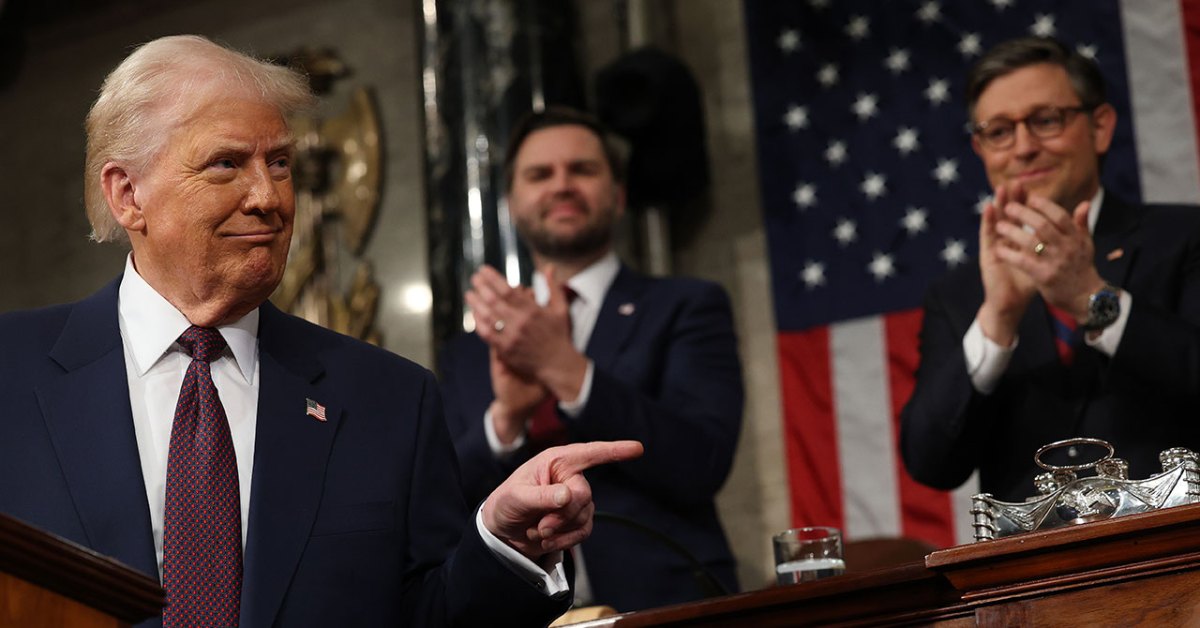
President Donald Trump will deliver the State of the Union address on Feb. 24. It will be his second speech to a joint session of Congress since returning to office.
Ahead of the address, here’s a look at U.S. public opinion on key policy issues, drawn from recent Pew Research Center surveys.
U.S. economy
As has been the case since the coronavirus pandemic, most Americans have a negative view of the nation’s economy, according to a Center survey from January.
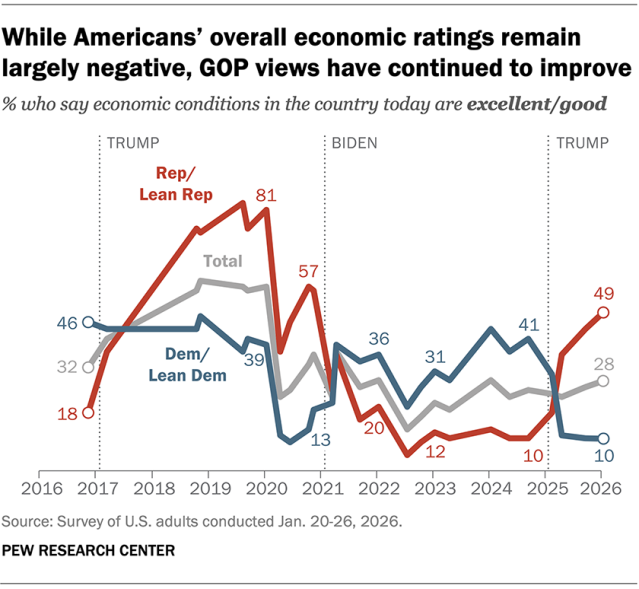
About three-in-ten adults (28%) say national economic conditions are excellent or good. Far more (72%) rate conditions as only fair or poor.
Attitudes vary widely by party. Around half of Republicans and Republican-leaning independents (49%) say the economy is excellent or good – 13 percentage points higher than in April 2025. Just 10% of Democrats and Democratic leaners say the same.
Views also differ by party when it comes to the effects of Trump’s policies on the economy so far. A 57% majority of Republicans say Trump’s policies have made the economy better, up 10 points since September. Only 3% of Democrats share this view. Democrats overwhelmingly say Trump’s policies have made the economy worse (85%).
Overall, 28% of Americans say the president’s policies have made economic conditions better, while 52% say they have made the economy worse.
Global tariffs
Tariffs have been a key economic tool for Trump during his second term. But in a major ruling on Feb. 20, the U.S. Supreme Court threw much of the White House’s tariff policy into question. The president has since called for a new 15% global tariff.
In our January survey – before the high court’s ruling – Americans expressed more negative than positive views of Trump’s tariffs. Six-in-ten disapproved of tariff increases, while 37% approved. Nearly all Democrats (93%) disapproved, while a narrower majority of Republicans (71%) were in favor.
Health care and other costs
Americans’ top economic concerns this year include how much they pay for health care, housing, food and consumer goods, according to the January survey.
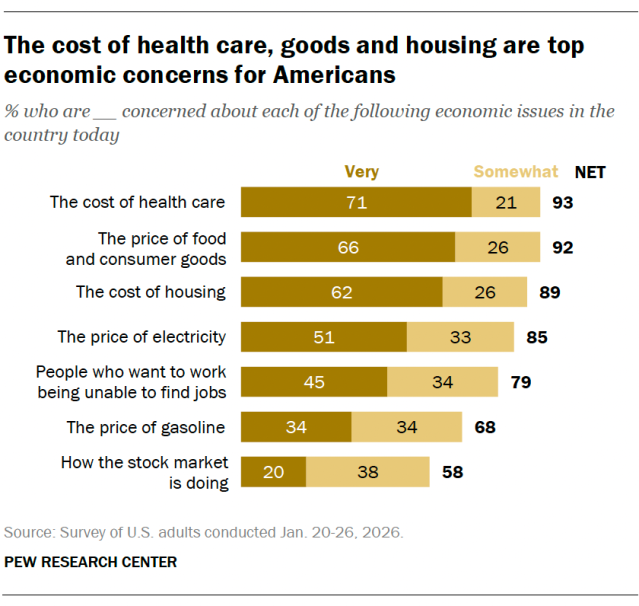
Roughly seven-in-ten adults (71%) say they are very concerned about the cost of health care. Most say the same about the prices of food and consumer goods (66%) and housing (62%).
More than half of adults in each party say they are concerned about these issues. But Democrats express more concern than Republicans.
In a separate survey conducted in November, around two-thirds of Americans (66%) said the federal government has a responsibility to make sure all Americans have health care coverage. Yet this group is split over whether the government should ensure coverage using a single national program (35% favored this option) or a mix of private and public programs (31%).
Immigration enforcement
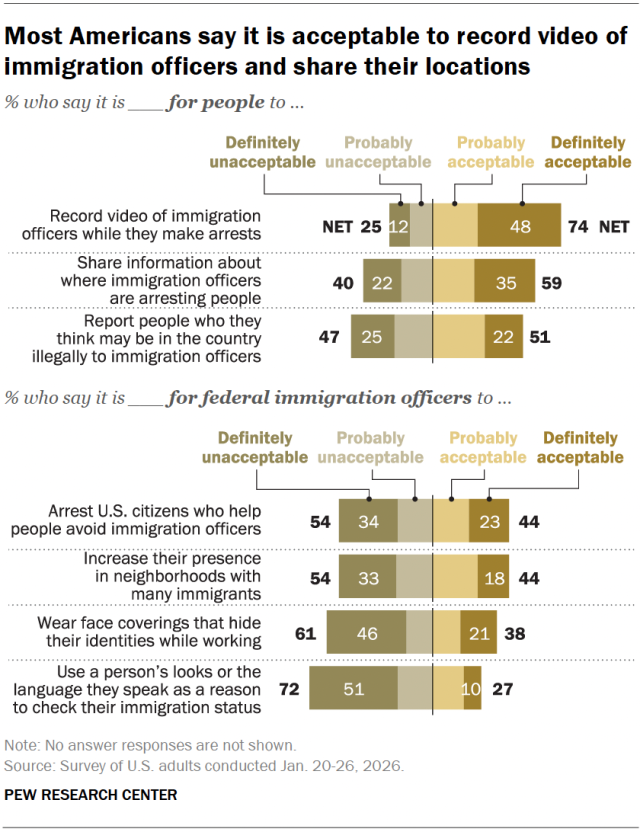
Amid high-profile immigration enforcement efforts, most Americans (72%) say it is unacceptable for federal immigration officers to use a person’s looks or the language they speak as a reason to check their immigration status, according to the January survey. Most (61%) also say it’s unacceptable for officers to wear face coverings that hide their identities while working.
The public is more divided when it comes to officers increasing their presence in neighborhoods where many immigrants live or arresting U.S. citizens who help others avoid immigration enforcement.
When it comes to civilian responses to enforcement efforts, majorities see it as acceptable for people to record video of immigration officers (74%) or share information about where arrests are happening (59%).
Republicans and Democrats differ sharply on most of these questions.
Border security
While Americans are divided on several of Trump’s immigration policies, a 62% majority favors a strong military presence at the U.S.-Mexico border, according to the January survey.
Since Trump’s return to office, U.S. Border Patrol encounters with migrants crossing into the United States from Mexico have fallen to their lowest level in more than 50 years, according to a recent Center analysis of federal data.
In 2025, encounters with migrants at the U.S.-Mexico border fell to their lowest level since 1970
Migrant encounters by U.S. Border Patrol at the U.S.-Mexico border, by fiscal year
Note: Beginning in fiscal 2020, totals combine apprehensions and expulsions into a new category known as encounters. Totals before March 2020 include apprehensions only. Some migrants are encountered more than once.
Source: U.S. Customs and Border Protection.
PEW RESEARCH CENTER
In 2025, encounters with migrants at the U.S.-Mexico border fell to their lowest level since 1970
Migrant encounters by U.S. Border Patrol at the U.S.-Mexico border, by fiscal year
| Fiscal year | Total encounters |
|---|---|
| 1960 | 21,022 |
| 1961 | 21,745 |
| 1962 | 21,103 |
| 1963 | 29,644 |
| 1964 | 32,519 |
| 1965 | 40,020 |
| 1966 | 62,640 |
| 1967 | 73,973 |
| 1968 | 96,641 |
| 1969 | 137,968 |
| 1970 | 201,780 |
| 1971 | 263,991 |
| 1972 | 321,326 |
| 1973 | 441,066 |
| 1974 | 571,606 |
| 1975 | 512,264 |
| 1976 | 607,499 |
| 1977 | 733,193 |
| 1978 | 789,441 |
| 1979 | 795,798 |
| 1980 | 690,554 |
| 1981 | 749,808 |
| 1982 | 745,820 |
| 1983 | 1,033,974 |
| 1984 | 1,058,276 |
| 1985 | 1,183,351 |
| 1986 | 1,615,844 |
| 1987 | 1,122,067 |
| 1988 | 942,561 |
| 1989 | 852,506 |
| 1990 | 1,049,321 |
| 1991 | 1,077,876 |
| 1992 | 1,145,574 |
| 1993 | 1,212,886 |
| 1994 | 979,101 |
| 1995 | 1,271,390 |
| 1996 | 1,507,020 |
| 1997 | 1,368,707 |
| 1998 | 1,516,680 |
| 1999 | 1,537,000 |
| 2000 | 1,643,679 |
| 2001 | 1,235,718 |
| 2002 | 929,809 |
| 2003 | 905,065 |
| 2004 | 1,139,282 |
| 2005 | 1,171,396 |
| 2006 | 1,071,972 |
| 2007 | 858,638 |
| 2008 | 705,005 |
| 2009 | 540,865 |
| 2010 | 447,731 |
| 2011 | 327,577 |
| 2012 | 356,873 |
| 2013 | 414,397 |
| 2014 | 479,371 |
| 2015 | 331,333 |
| 2016 | 408,870 |
| 2017 | 303,916 |
| 2018 | 396,579 |
| 2019 | 851,508 |
| 2020 | 400,651 |
| 2021 | 1,659,206 |
| 2022 | 2,206,436 |
| 2023 | 2,045,838 |
| 2024 | 1,530,523 |
| 2025 | 237,538 |
Note: Beginning in fiscal 2020, totals combine apprehensions and expulsions into a new category known as encounters. Totals before March 2020 include apprehensions only. Some migrants are encountered more than once.
Source: U.S. Customs and Border Protection.
PEW RESEARCH CENTER
Most Americans oppose another key Trump policy related to the border: suspending all applications for asylum. Around two-thirds of adults (66%) oppose this policy.
Energy policy
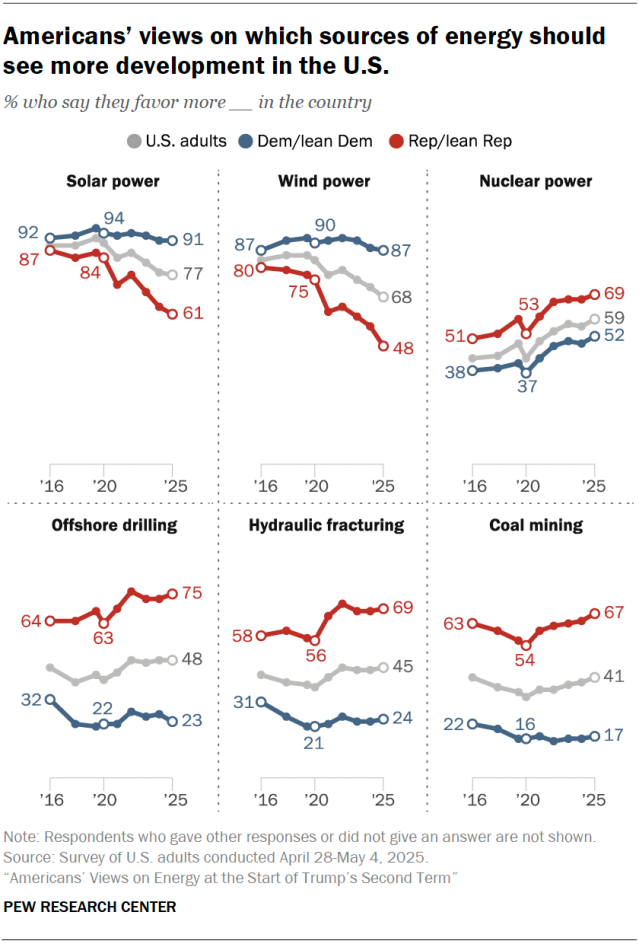
Americans generally favor expanding solar (77%) and wind (68%) power, but somewhat less so than in the first Trump administration, according to a spring 2025 survey. These overall declines are driven by decreases in support among Republicans.
By contrast, nuclear power has seen an increase in support in recent years (now at 59% overall), with growing support among Republicans and Democrats alike.
Environmental regulation
Since the beginning of Trump’s second term, the Environmental Protection Agency has rolled back a number of regulations. These actions include the recent repeal of the 2009 greenhouse gas “endangerment finding,” which had served as the basis for regulating emissions from vehicles, power plants and other sources.
Slightly more than half (54%) of Americans say it’s possible to cut back on environmental regulations and still protect air and water quality in the U.S., while 45% say it’s not possible, according to the spring 2025 survey.
Role in Venezuela
In a survey conducted soon after the U.S. military operation that ousted Venezuelan President Nicolás Maduro, 45% of Americans said the U.S. shouldn’t be involved much or at all in Venezuela’s governance over the next several months. Another 32% said the U.S. should be somewhat involved, while 21% said it should be extremely or very involved.
The public is similarly divided on whether U.S. companies should be given access to Venezuelan oil: 37% support this, 40% oppose it and 22% are not sure.