Our planet is unique for its ability to sustain abundant life. From studies of the rock record, scientists believe life had already emerged on Earth at least 3.5 billion years ago and probably much earlier.
But how a habitable environment developed, and how the very first life emerged on the early Earth, remain puzzling. One of the big challenges for Earth to be habitable in its infancy was the weak solar energy it received.
Astrophysical models indicate that the sun had only about 70 per cent of its current luminosity when the Earth was born around 4.5 billion years ago. That would have resulted in Earth’s surface being frozen until around two billion years ago.
Nonetheless, scientific investigations indicate the Earth had warm oceans and habitable environments as early as 4.4 billion years ago. This contradiction is known as the faint young sun paradox.
Solving this paradox and the generation of the first life both involve a key chemical compound — ammonia. But the source of ammonia on the early Earth before biological nitrogen processing emerged remains unknown.
Colleagues in China and my research group at the University of Alberta recently published our study of minerals deposited from hydrothermal fluids in oceanic crusts drilled from the South China Sea basin. We discovered that mineral-catalyzed chemical reactions in underwater hydrothermal systems can produce the necessary ingredients for a habitable world and life on Earth.
Hypothesis of the origin of life
Earth’s first life is hypothesized to be generated by a series of abiotic processes, also known as abiogenesis. Under this hypothesis, the building blocks of the first life were synthezised on Earth from basic inorganic compounds by abiotic reactions, or were brought to here by meteorites.
In 1953, American chemist Stanley Miller, then a graduate student working with Nobel Prize laureate Harold Urey at the University of Chicago, discovered production of amino acids in his experiments simulating lightning in an early-Earth atmosphere composed of water moisture and several gases (methane, ammonia and hydrogen molecules).
These life-building blocks could subsequently deposit into the ocean for life development. This ground-breaking discovery by Miller implied that abiogenesis of life on Earth is possible.
Gases like methane, ammonia and hydrogen were not only essential compounds for synthesis of organic matter in Miller’s experiments. They are also key ingredients to establishing a habitable environment on early Earth.
They have all been proposed as potential contributors, either directly as greenhouse gases or indirectly as amplifiers of other greenhouse gases, to warm up early Earth’s surface under the faint young sun.
Where did these gases come from?
A problem, though, is that these gases were not the primary components on early Earth’s surface in the first place. Instead, the dominant forms of carbon and nitrogen were carbon dioxide and dinitrogen.
That means the very first step toward making Earth habitable and generating the first life had to be inorganic reactions to turn carbon dioxide into methane and dinitrogen into ammonia, also known as abiotic carbon and nitrogen reduction reactions.
Where and how did these reduction reactions take place?
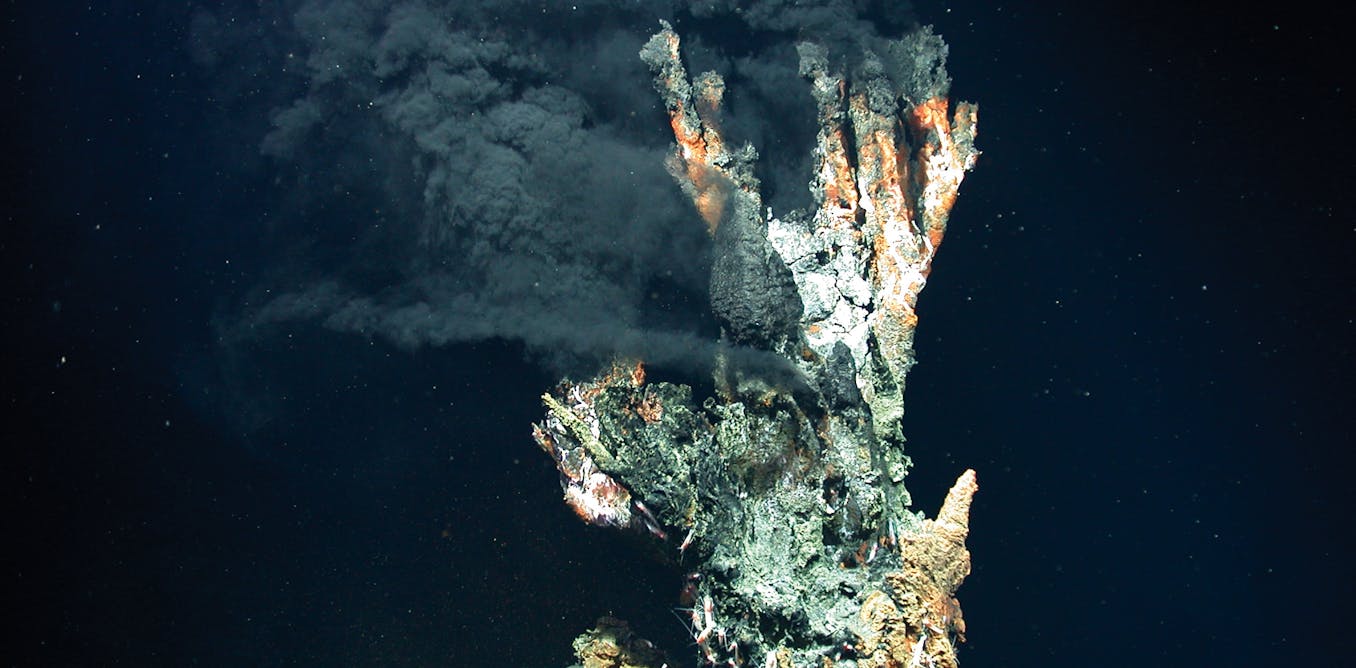
The world’s ocean floors contain abundant hydrothermal systems where cold seawater flows into deep oceanic crust and subsequently mixes with ascending magmatic fluids. The mixed hot fluids are emitted back through hydrothermal vents such as black smokers or white smokers.
Along this pathway, water and dissolved components can react with primary minerals in the oceanic crust to produce secondary minerals and other byproducts. Methane and dihydrogen, formed by mineral-catalyzed abiotic reduction reactions during this process, have been widely observed in the emitted hydrothermal fluids.
Therefore, underwater hydrothermal systems have been considered as the most likely incubator for habitable environment and the origin of life.
Searching for evidence
Yet there still exists a missing piece in this picture: the abiotic reduction of dinitrogen has not been confirmed to occur in hydrothermal systems. Scientists have searched hard for evidence of this reaction, abiotic ammonia, but have had no luck so far.
The ammonia (mostly in its dissolved form, ammonium ion) that has been detected in hydrothermal fluids collected from active vent mouths turned out to be mainly biological and not abiotic in origin.
The relatively small amount of abiotic ammonium there might be can easily be concealed by the large amount of biological ammonium in seawater. It is impossible to avoid seawater contamination while collecting submarine hydrothermal fluid samples.
However, secondary minerals deposited from hydrothermal fluids can lock some ammonium into their internal structures and protect it from being contaminated by shallow seawater and mixing with biological ammonium. Therefore, studying secondary minerals in the deep oceanic crust can better unravel the ammonium source and producing mechanism in the deep hydrothermal systems.
However, such samples are not easily to collect. The International Ocean Discovery Program has made tremendous efforts to drill deep into the oceanic crust to collect samples. Luckily, a set of secondary mineral samples were discovered in a 200-metre drill core from the South China Sea.
A missing piece of the puzzle
For our study, we looked into a specific chemical feature, namely nitrogen isotopes, for the ammonium locked in the hydrothermal minerals.
Nitrogen has two isotopes with atomic mass 14 and 15, respectively. Mineral-catalyzed abiotic dinitrogen reduction strongly prefers to use the one with an atomic mass of 14. That results in a unique nitrogen isotope signature in the ammonium it produces.
Our results are consistent with this isotopic signature. This demonstrates production of ammonia or ammonium by abiotic dinitrogen reduction in underwater hydrothermal systems.
This discovery adds a missing piece of puzzle to our theories about the origins of life on Earth. These underwater hydrothermal systems at the bottom of the ocean enabled the first-step reactions of all life-constituting elements on our planet.